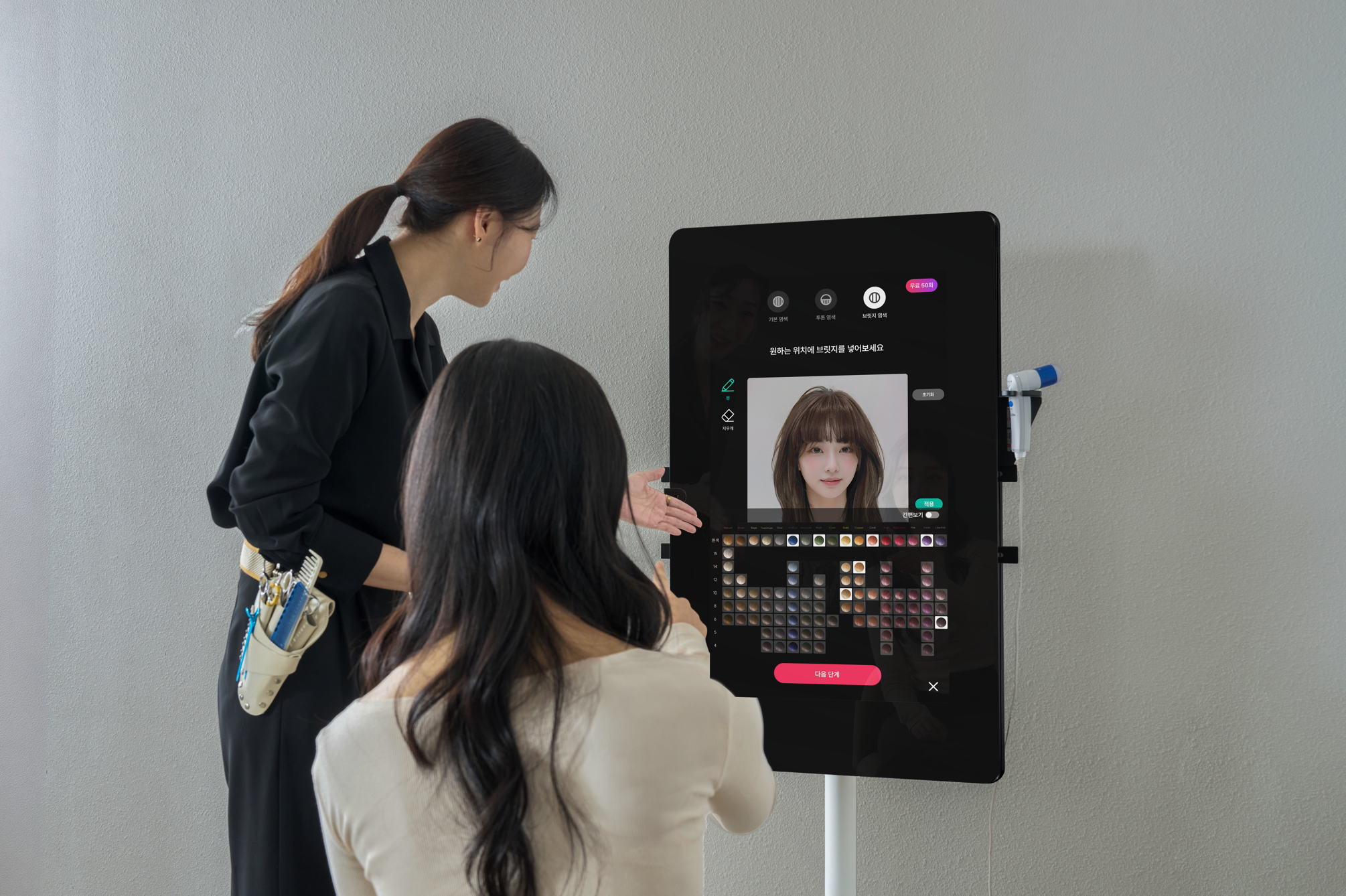
Choosing a hairstyle at a salon usually depends on imagination. A customer shows a photo on their smartphone, the stylist explains the expected result based on experience, and the actual look is only revealed after the service is complete. Mirrorroid moved that process onto the mirror. In front of the same mirror customers already look into, it analyzes the face and scalp and lets them preview changes in hair color and style before the service begins.
Not a New Screen, but the Mirror You Already Use
Mirrorroid chose the mirror as its interface. The same functions could be offered on a smartphone or tablet, but that would require customers to learn a new device and stores to change their existing flow. A mirror, by contrast, is something salon customers already look at throughout consultation and treatment. Mirrorroid adds face and scalp analysis, hair-color simulation, and personal color features to that familiar surface, allowing customers to see how they might look without shifting their gaze elsewhere.
Analysis, style recommendations, and consultation history management all take place on a single screen. The company is also extending the facial recognition and image-compositing technologies developed for its smart mirror into unmanned photo services through Mirart Studio and tourism photography through SNAP & TOUR.
Milestones
- 2019Mirrorroid founded · Development of AI smart mirror begins
- 2021Seed investment secured from Infobank · Commercial rollout in salons and beauty stores
- 2022Japanese subsidiary Mirart established · Pre-A investment secured from Dongmun Partners
- 2024Unmanned photo solution Mirart Studio launched · CES 2024 Innovation Award · Minister of SMEs and Startups Award
- 2025SNAP & TOUR tourism photography service developed · Partnerships with KDDI and UCS in Japan · Awards including KES 2025
- 2026Smart mirror PoC with LG H&H · Hyundai Department Store pop-up · Follow-on investment of around KRW 2 billion underway
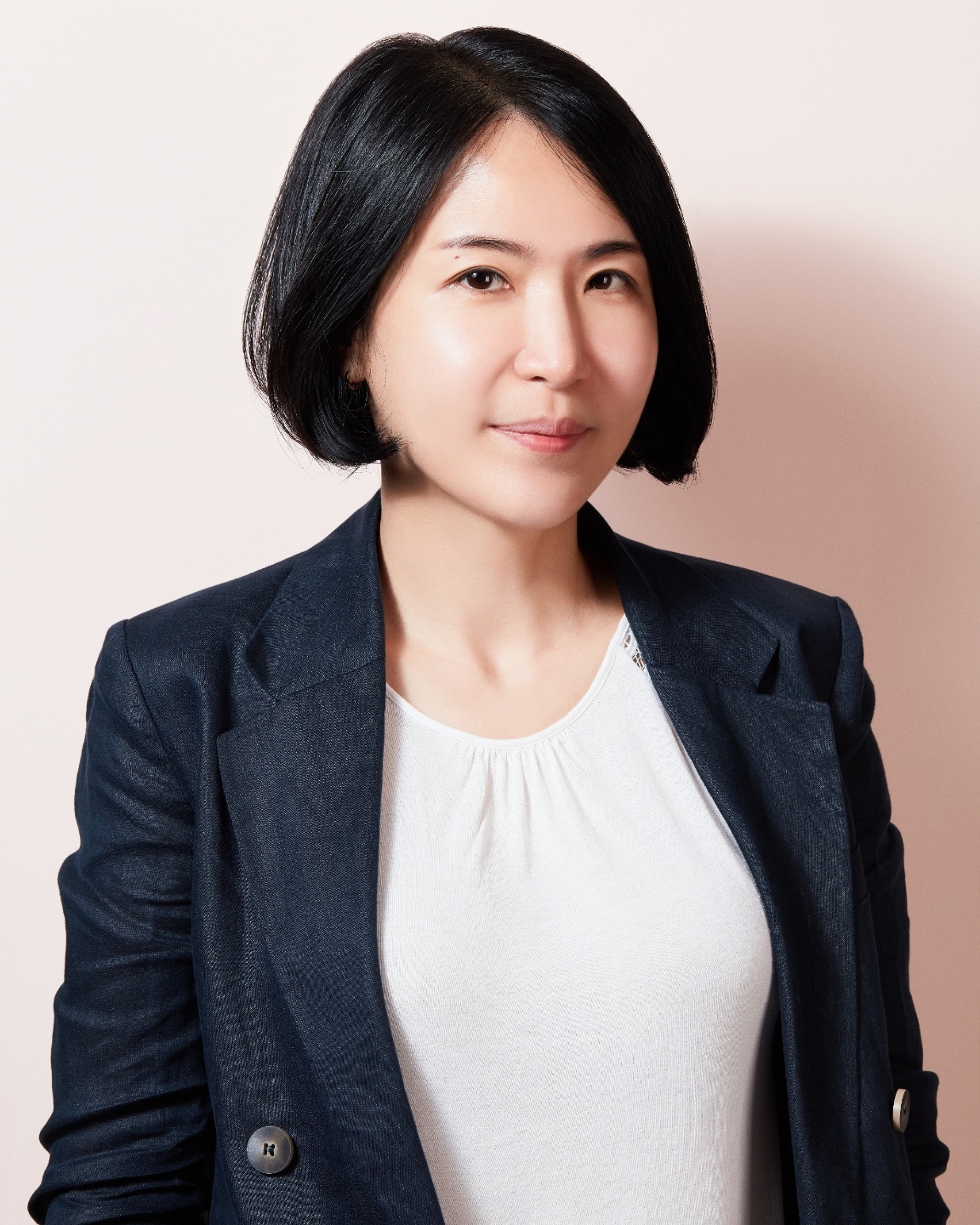
Ji-hye Jung
CEO, Mirrorroid · Founded in 2019
Mirrorroid is a visual-tech company developing AI smart mirrors. Using the mirror customers already look into as an interface, it brings face and scalp analysis, as well as hairstyle and hair-color simulation, directly into the consultation experience. The image technologies developed through its smart mirror business are also being extended into unmanned photo and tourism photography services.
mirrorroid.co.kr →What scene in a hair salon became the starting point for the business?
The business began with a familiar scene: a customer showing a hairstyle photo on their smartphone while the stylist explained the expected result based on words and experience. Before the service, customers had no easy way to know whether the chosen style would actually suit them, and sometimes the customer and stylist were imagining completely different results.
We thought that if customers could preview hairstyles and hair-color changes in the mirror — the most natural place to look at themselves — we could reduce that uncertainty. That led us to begin developing the AI smart mirror, and we later expanded its functions into face and scalp analysis, personal color, and beauty consultation. Some of the image-analysis and compositing technologies accumulated through smart mirror development are now also being applied to the unmanned photo solution Mirart Studio and the tourism photography service SNAP & TOUR.
How does Mirrorroid change the conventional beauty consultation process?
Traditionally, beauty consultations involve customers showing reference photos while stylists explain the likely outcome based on experience. Customers only see the actual result after the service is finished, and it can also be difficult to judge objectively which colors or styles suit them best.
Mirrorroid's AI smart mirror analyzes the face, skin, and scalp, while allowing customers to preview changes in hairstyle, hair color, and personal color directly on the mirror display. Processes that were once separated into multiple steps — analysis, consultation, and style recommendations — can be completed within minutes on a single screen, while consultation results and usage history can also be managed.
This allows customers to preview the expected result before treatment and reduce uncertainty in their choices, while stylists can provide more specific consultations based on visualized information. For stores, it helps maintain a consistent level of consultation quality while increasing customer engagement and service satisfaction.
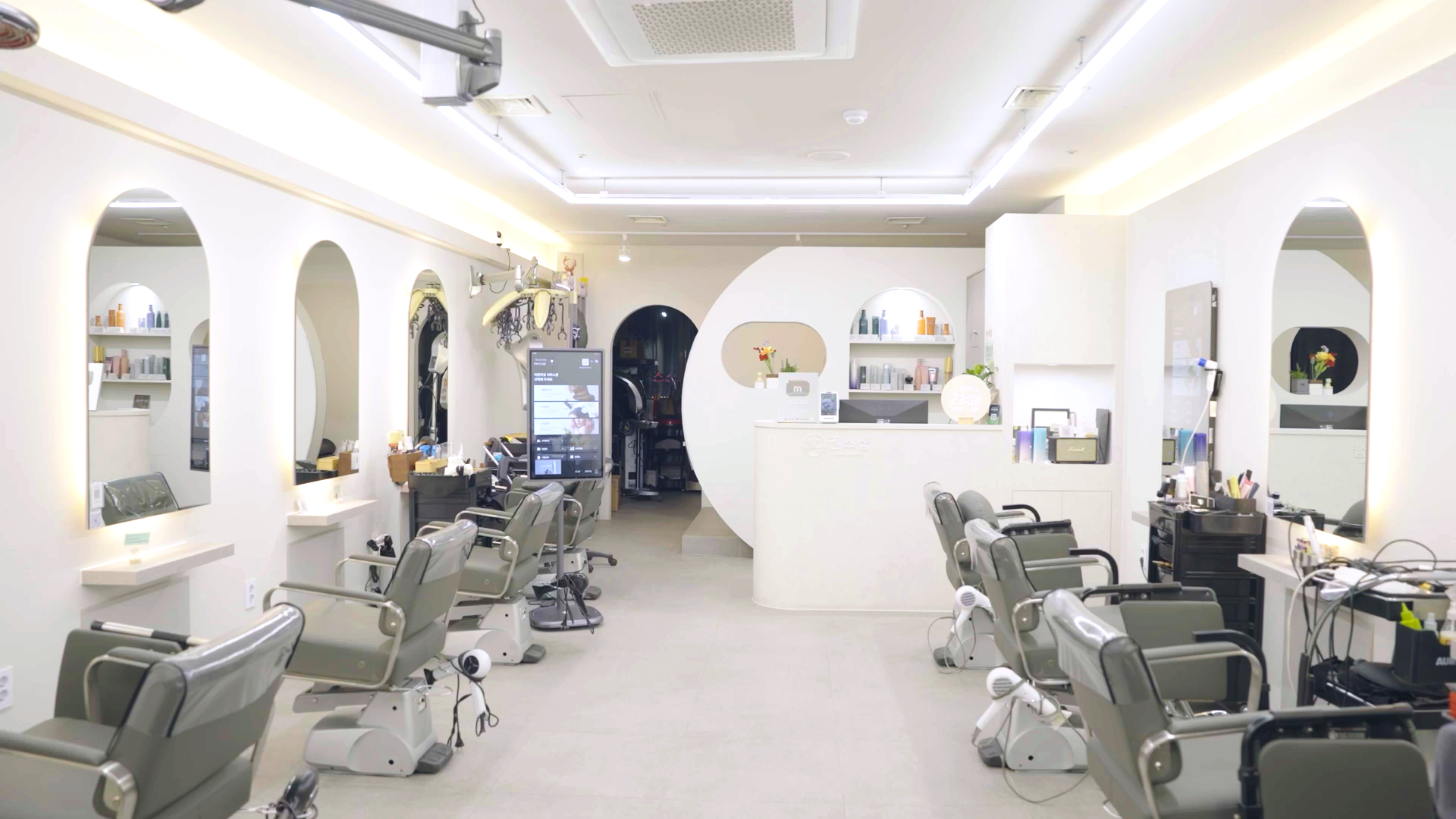
A Mirrorroid smart mirror installed among salon mirrors, placed exactly where customers already look throughout consultation and treatment.
Of all the possible screens, you chose the mirror. What makes a mirror different?
A mirror is an interface that anyone can use naturally without learning anything new. In salons and beauty stores in particular, customers spend most of the consultation and treatment process in front of a mirror, so it is not merely an interior element but a key point of interaction in the customer experience.
With a smartphone or tablet, users look at a photo inside a screen. With a smart mirror, they can look at themselves as they are while simultaneously seeing a transformed version. The biggest difference is that AI analysis and virtual try-on can be introduced without changing where the customer looks or disrupting the existing consultation flow.
We see the mirror not simply as something that reflects a person's appearance, but as the most intuitive interface connecting the customer, the store, and digital services.
You have expanded from salons to photo studios and homes. What do you focus on most when the space changes?
Each space has a different purpose and pattern of use, so rather than applying the same technology unchanged, we have to redesign the user experience for that environment.
In salons, the system needs to function as a consultation tool shared by the stylist and customer. Features such as face and scalp analysis, hairstyle simulation, and hair-color simulation are important because they improve the professionalism and credibility of the consultation. In the home, by contrast, ease of use, access to content, mobility, and harmony with the interior matter more than professional consultation features.
Ultimately, when the space changes, I believe the most important thing to redesign is not the function itself, but the experience — based on what users expect in that space and how they naturally behave there.
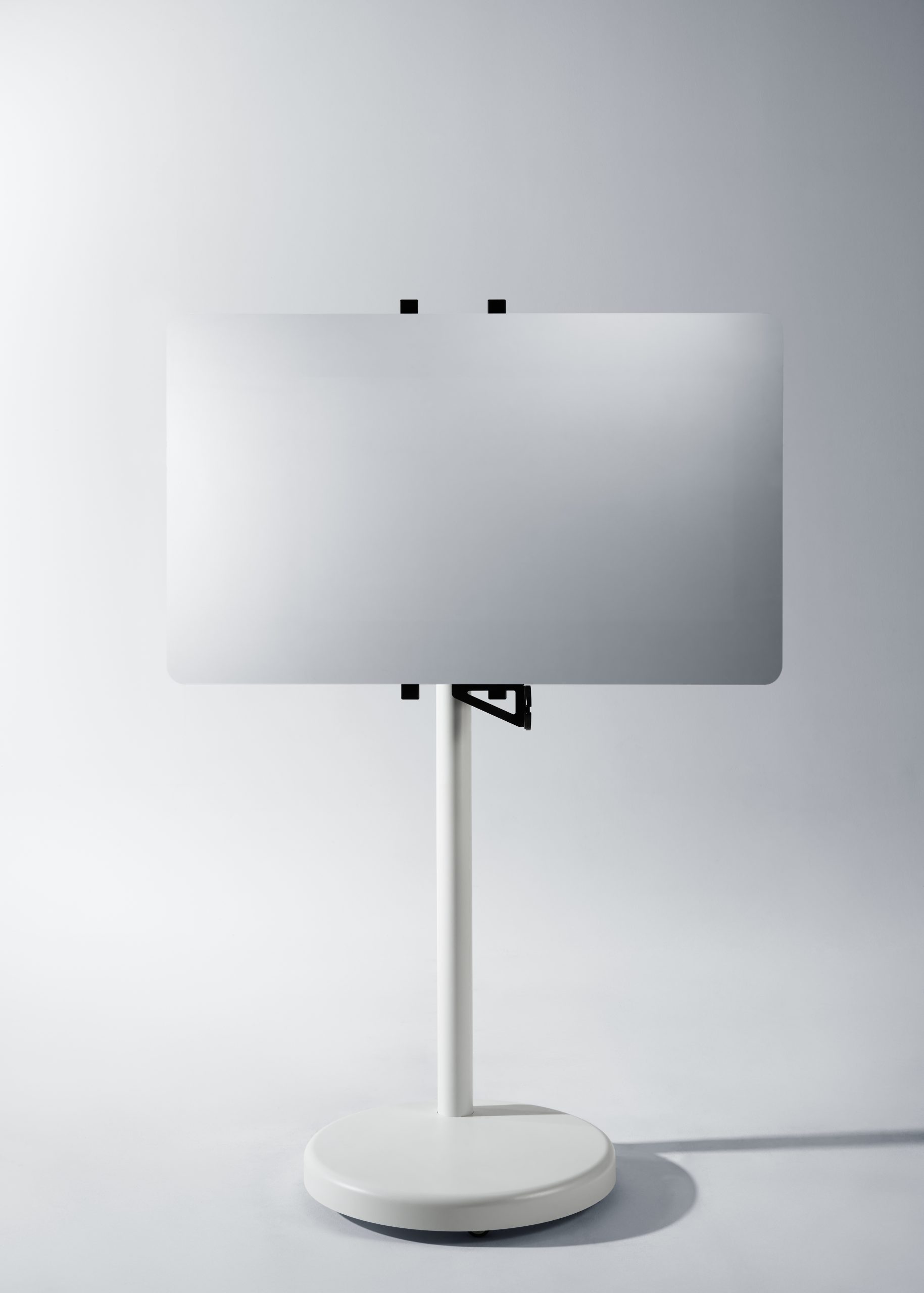
Mirrorroid develops not only the software on the screen, but also the mirror hardware itself, integrating cameras, lighting, and displays.
You develop both software and hardware. What has it been like building the two together?
Developing software and hardware together means considering everything from product design and manufacturing to installation and maintenance, so the scope is broad and requires extensive testing.
Physical conditions such as the position and angle of the camera, lighting brightness, display color and resolution, and even the distance between the user and the mirror directly affect AI analysis and image-compositing results. Improving the algorithm alone does not guarantee good results in an actual store.
On the other hand, developing both sides gives us the advantage of creating products optimized for real environments. We can integrate the AI algorithm, camera, lighting, display, and mirror structure into a single user experience, and when a problem occurs on site, we can diagnose and improve it from the perspective of the entire system. This integrated development capability is what allows Mirrorroid to go beyond being a software provider and deliver a complete smart mirror solution that can be installed and operated continuously in real spaces.
What direction are you planning for Mirrorroid from here?
Mirrorroid began with AI smart mirrors for hair salons and is expanding into beauty stores, educational institutions, retail spaces, and homes. Beyond hairstyle and hair-color simulation, we are developing the platform to support the broader beauty consultation process, including face, skin, and scalp analysis, personal color, product recommendations, and consultation history management.
Going forward, we plan to provide content tailored to individual stores and brands, and develop the service so that customers' trial experiences connect naturally to actual consultations and product purchases. We are also applying some of the facial recognition, image analysis, and compositing technologies developed through the smart mirror business to photo and tourism services such as Mirart Studio and SNAP & TOUR. Our core business, however, remains the smart mirror, and our main focus will continue to be the digital transformation of beauty spaces and expansion into global markets.
You must have learned a great deal from applying the technology in real spaces. What stood out most?
The most practical benefit was being able to test Mirrorroid's image technology and service operations at Hoban Hotels & Resorts locations visited by real customers. At Forest Resom, we operated the SNAP & TOUR service using the person-recognition and image-compositing technologies accumulated through our smart mirror business. This allowed us to observe tourist participation rates, photo selection and printing behavior, visitor flow, and equipment operation in a real environment.
During the demonstration period, a total of 3,473 photos were taken and 1,619 were printed, resulting in a print conversion rate of about 46.6%. This gave us more than a technical validation — we were able to gather actual customer-response and operational data, while confirming that Mirrorroid's AI image technology could also be applied beyond beauty spaces to tourism and resort environments.
Looking five years ahead, what do you hope Mirrorroid will become?
The future we envision is one where the mirror goes beyond simply reflecting a person's appearance and becomes an AI interface that understands the user and recommends styles and information suited to them.
In five years, we hope people will encounter Mirrorroid smart mirrors naturally not only in salons and beauty stores, but also in cosmetics stores, educational institutions, hotels, and homes. Standing in front of the mirror, users will be able to analyze their condition, preview desired changes, and receive recommendations for suitable services and products.
Our goal is to build an AI smart mirror platform that can be deployed across a wide range of spaces in Korea and abroad, and to establish Mirrorroid as a visual-tech company leading the digital transformation of the global beauty market.