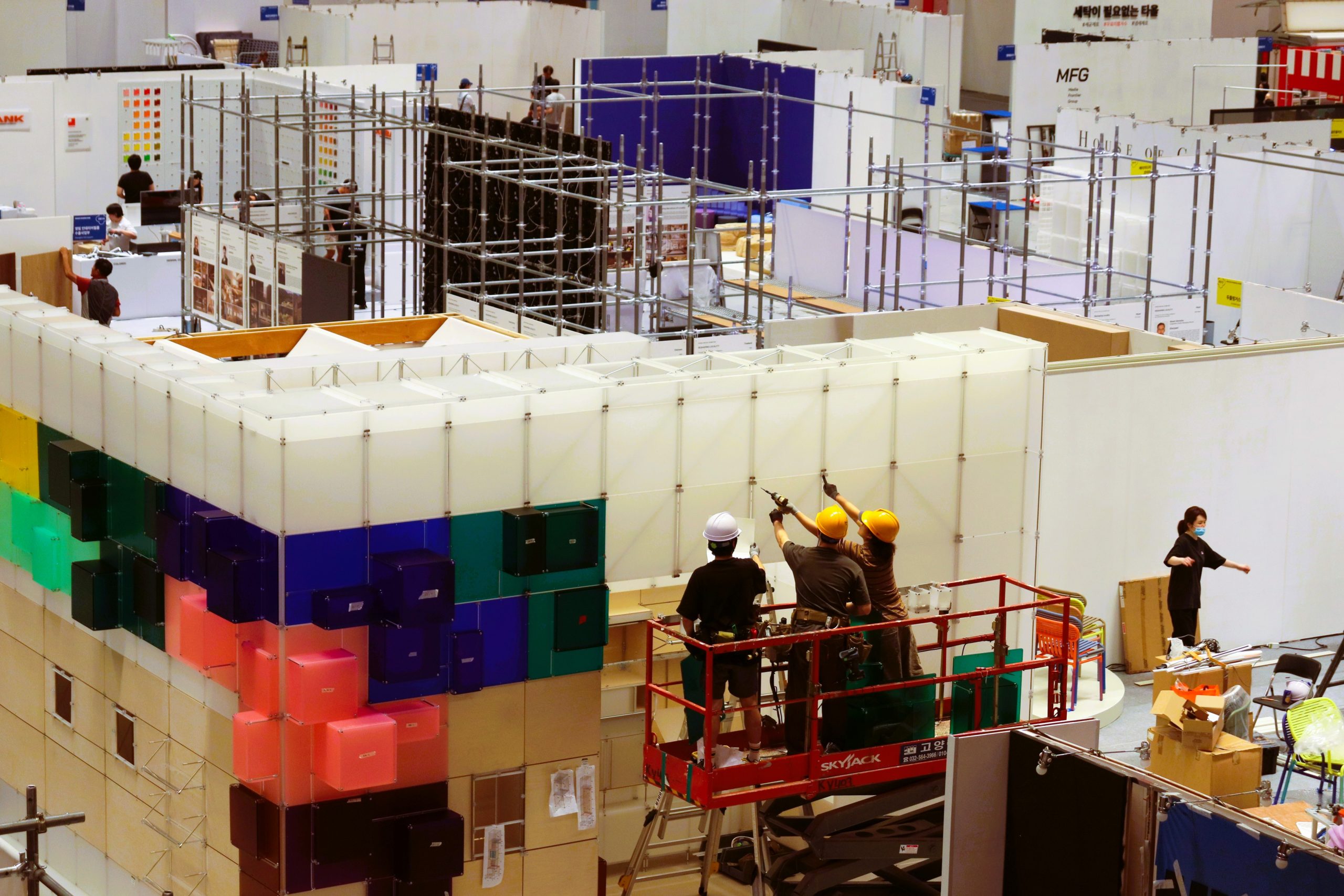
Where Have People Disappeared from the Jobsite?
Start with the numbers. In 2024, 207 workers lost their lives in accidents on construction sites. More than half of them — 106 people, or 51% — died from falls. High-rise exterior walls, painting from scaffolding, tightening bolts on steel frames. Much of the work that required people to climb to dangerous heights was also the source of the greatest risk.
Then came the Serious Accidents Punishment Act. When a serious accident occurs on site, company executives can be held directly criminally responsible. Safety training and protective equipment alone are no longer enough to shield management from liability. The workforce is shrinking, the risks remain, and responsibility has grown heavier. These three pressures are now weighing on site managers at the same time.
The problem is that there are fewer and fewer people available to do the work. Skilled construction workers are aging rapidly, while younger workers are reluctant to enter jobs that are difficult, dangerous, and dirty. The risks remain, but finding people to fill those roles becomes harder every year. This is why robots are moving from something that is 'nice to have' to something sites can no longer do without.
The government has followed the same trajectory. Since 2020, the Ministry of Land, Infrastructure and Transport has invested KRW 196.9 billion over six years in smart construction technology R&D. More than 120 companies and universities have participated, with the goal of achieving a 25% improvement in productivity, construction time, accident rates, and digitalization. Automated earthwork, remote and automated structural construction, and integrated construction safety monitoring were designated as key areas. The robots now moving across jobsites are both beneficiaries and executors of that policy.
First, the Major Companies Paved the Way
Once the government laid the groundwork, large corporations were the first to scale the market. In 2024, Hyundai E&C opened its Robotics Lab in Yongin, bringing together nine different technologies in one place: from Spot, the quadruped robot used to inspect blind spots, to three types of drones for outdoor, indoor, and underwater inspection, and even remote-control systems capable of operating cranes from 800 kilometers away. The ambition is clear — to bring robotics into the entire construction process, from patrol and surveying to remote construction. Doosan Robotics, meanwhile, has partnered with NVIDIA and shifted toward 'physical AI.' The idea is to train motions repeatedly in virtual environments and transfer them to real robots. Its robotic arms are already pushing waste into incinerators operating at 1,200°C, taking people out of extreme-heat environments.
Hyundai Engineering has focused on finishing work. Floor finishing, once done by workers crouched over hand trowels, and exterior painting, once carried out while suspended from ropes, have both been handed over to robots. Its exterior painting robot was designated a New Construction Technology by the Ministry of Land, Infrastructure and Transport in 2026. Samsung C&T has introduced robotic arms to tasks such as spraying fireproofing material onto structural steel and installing heavy access-floor panels — jobs that once required workers to remain suspended near ceilings — cutting time and labor by around 40%. Armed with capital and access to large jobsites, major construction companies have demonstrated at scale that robots can save money and protect workers. If large companies built the ecosystem and proved the scale, startups have moved into the narrower gaps that were still left empty.

Areas where major construction companies have introduced robots — from patrol and inspection to high-temperature work and lifting. Graphic = KOREA BUILD.
Startups Begin Where the Gaps Remain
Those gaps differ from one site to another: material transport, safety inspection, and construction work that still requires people to hang at height. The first is material transport — heavy, repetitive work that often stops altogether at night.
Gole Robotics — A Material-Handling Robot That Fills the Night Shift
Gole Robotics CEO Dong-min Lee saw that gap up close during more than a decade at POSCO E&C. Every night, workers had to carry heavy finishing materials such as engineered flooring and tiles by hand into individual apartment units. "What if we could use the nighttime, when no one is working?" That question led to the GL-1. It is an autonomous material-handling robot that transports boxed finishing materials such as flooring and tiles, as well as mortar and sanitary fixtures, through apartment construction sites on its own.
Its key strength is that it can move precisely without relying on a communications network. Unlike logistics warehouses, construction sites have unstable wireless signals and environments that change every day. GL-1 navigates without Wi-Fi or LTE, mapping its surroundings on its own and determining its position through SLAM using preloaded drawings. Because jobsite data does not need to leave the site, it also meets security requirements. The EVW-1 extends that autonomy vertically. Attached to an elevator control panel, it allows the robot to physically press buttons, call the elevator, and move between floors without replacing or integrating with existing building systems. Horizontal and vertical material transport can therefore be connected into a single workflow.
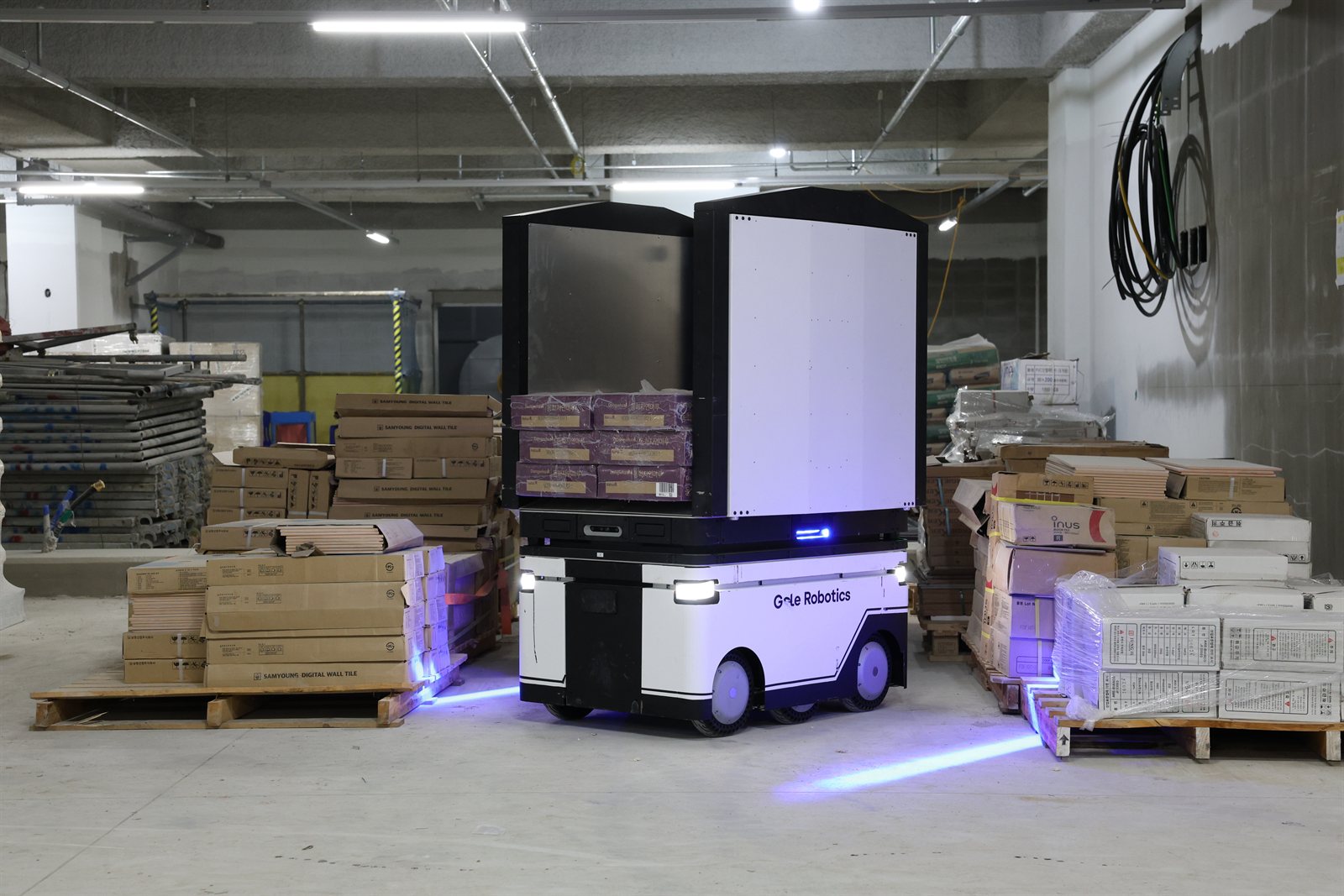
Gole Robotics' GL-1 material-handling robot. It operates autonomously even on construction sites without a communications network. In October 2024, it publicly demonstrated vertical transport at a POSCO E&C apartment project in Songdo, Incheon, independently entering and exiting an elevator.
© Gole Robotics
In October 2024, at a POSCO E&C apartment project in Songdo, Incheon, a GL-1 carrying materials was publicly demonstrated entering an elevator on its own and reaching the designated floor. CEO Dong-min Lee said, "If robots can take over the hardest and most dangerous work that people used to carry by hand at night, skilled workers can focus on critical work the next day while the risk of accidents is fundamentally reduced." Earlier this year, Gole Robotics won three Innovation Awards at CES 2026 and has raised KRW 6.9 billion in cumulative funding. In April 2026, it also secured a series of government projects, including a KRW 28 billion national construction robotics project led by the Ministry of Land, Infrastructure and Transport, and is expanding deployment to apartment construction sites in Jeonju, Songpa, and Gangneung.
IT-ONE — Eyes That See Accidents Before They Happen
IT-ONE focuses on two areas: work at height and safety inspection. The first is giving sites a way to see accidents before they happen. CONIT Eye, part of the company's smart construction platform CONIT, uses vision AI to analyze footage from CCTV cameras and drones already installed on site, identifying hazards such as falls or entrapment in real time without requiring additional robots. Repeated accident patterns and high-risk time periods are accumulated as data, giving each site a basis for redesigning its safety measures.
The company also hands dangerous work directly to robots. CONIT Runner creates precise grooves on uncured concrete surfaces to improve bonding between layers. A rough finishing task that once required 15 workers can be completed in 40 minutes by two robots and one operator. The technology received a CES 2025 Innovation Award. Under the company's COBO robot brand, a dual-arm robot for work at height can be remotely operated from the ground, reducing the need for workers to climb scaffolding for repetitive tasks. Armstrong, another dual-arm robot developed by transferring heavy-duty robotics technology from the Korea Atomic Energy Research Institute, can lift 200 kilograms at once, replacing manual handling of heavy loads.
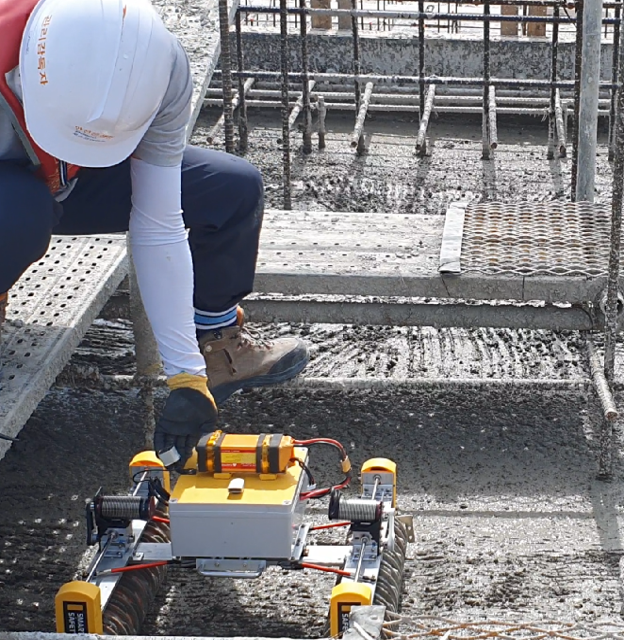
CONIT Runner creating grooves in a concrete surface.
© IT-ONE
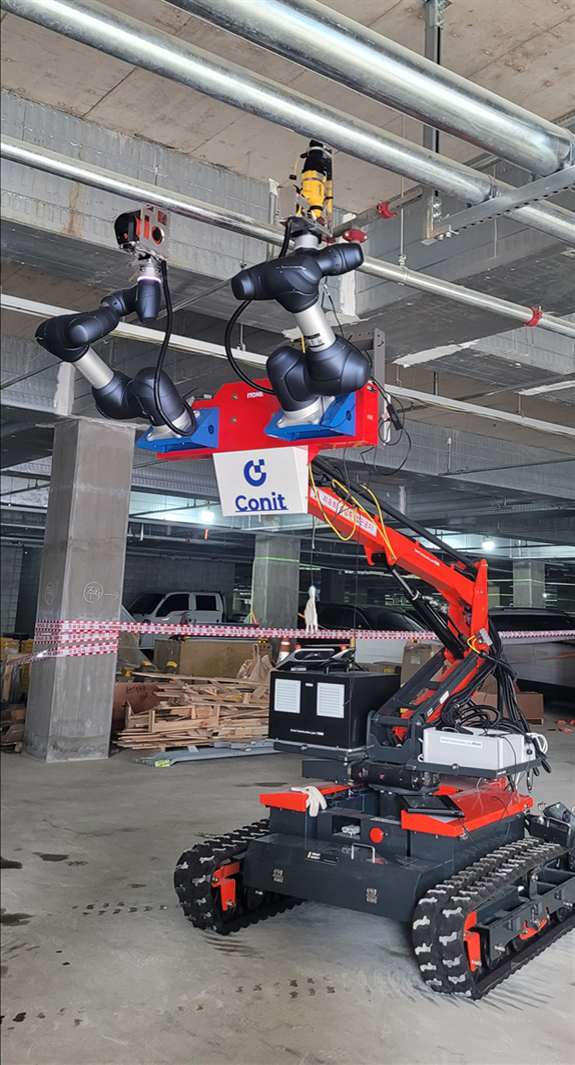
A dual-arm robot for work at height, remotely controlled from the ground.
© IT-ONE
Donga Robotics — Construction Without Limits, 3D Structures Built by Robots
Donga Robotics brings 3D printing onto the construction site, building structures by depositing concrete layer by layer without formwork. Once design data is entered, the company's proprietary software analyzes it and immediately converts it into precise robot movement paths and concrete extrusion volumes. This makes it possible to construct curved or irregular forms that are difficult to achieve with conventional methods.
Its flagship 3D concrete printer, ACRO-IRT, goes beyond the six degrees of freedom of a standard robotic arm by integrating four additional axes into a 10-degree-of-freedom, or 10-DOF, articulated system. This dramatically expands the printable work area and enables more complex forms. The ACRO series ranges from research equipment used by universities and institutes to test new material mixes and control technologies, to commercial construction systems mounted on tracked vehicles or trucks for deployment directly on jobsites.
The technology is not limited to curved landscape structures or small houses. Donga Robotics has secured a patent for a retaining-wall method in which hollow wall structures are printed and then supported by earth pressure, allowing the technology to move into civil engineering sites with irregular slopes. The company's next target is hazardous environments that are difficult for people to access, such as disaster recovery sites. It is currently working with industry, academia, and research institutions to demonstrate 'physical AI' technologies that allow robots to build and repair structures autonomously.
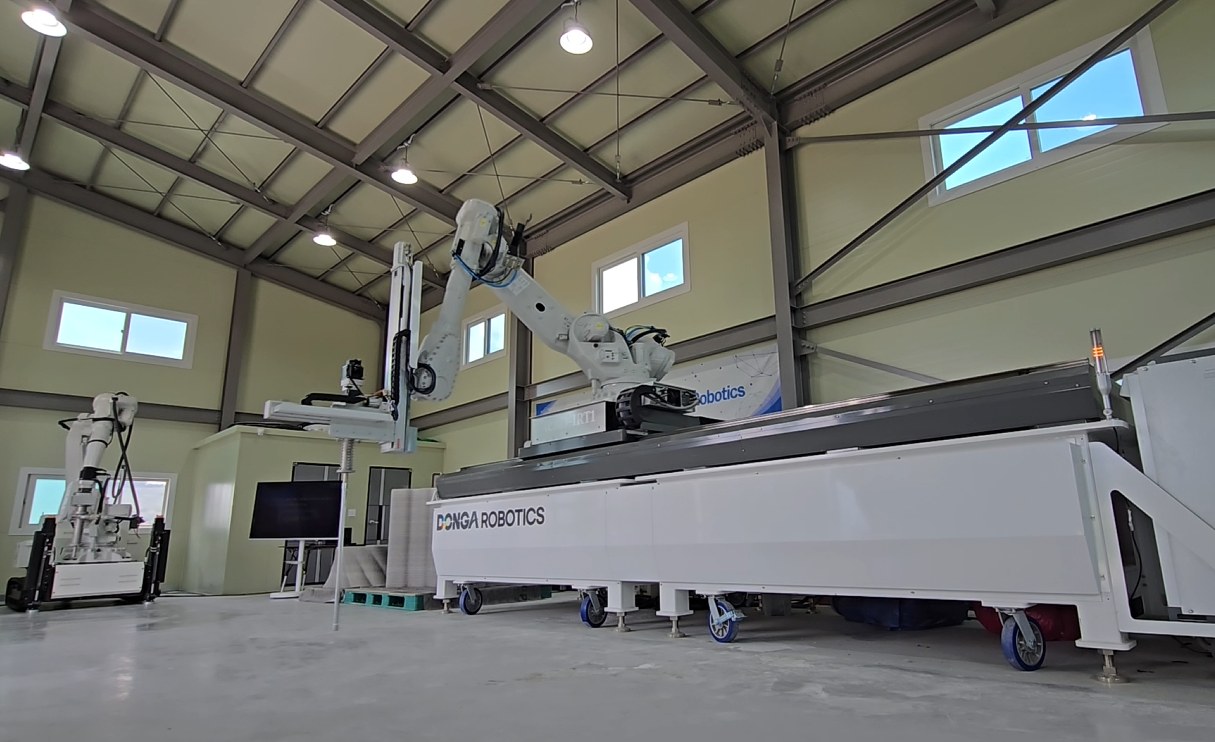
Donga Robotics' 3D concrete printing facility, equipped with a large gantry printer and articulated robotic arms.
© Donga Robotics
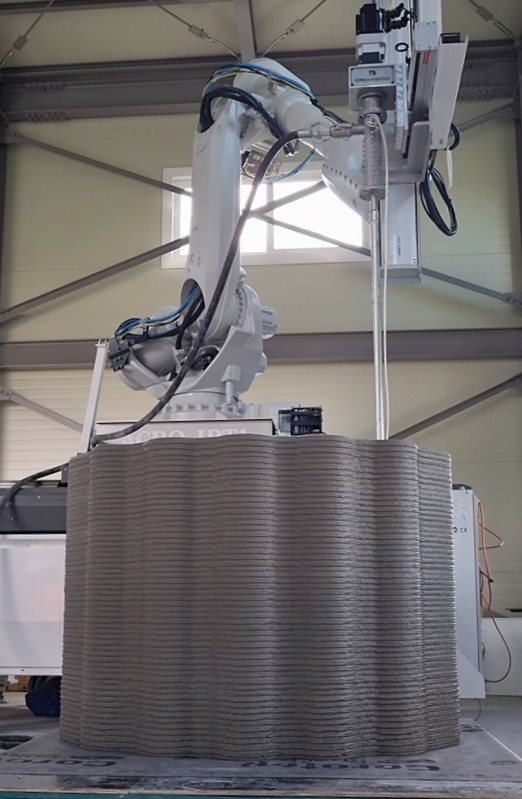
An articulated robotic arm builds an irregular structure by depositing concrete one layer at a time without formwork.
© Donga Robotics
Spanner — Making Existing Equipment Autonomous
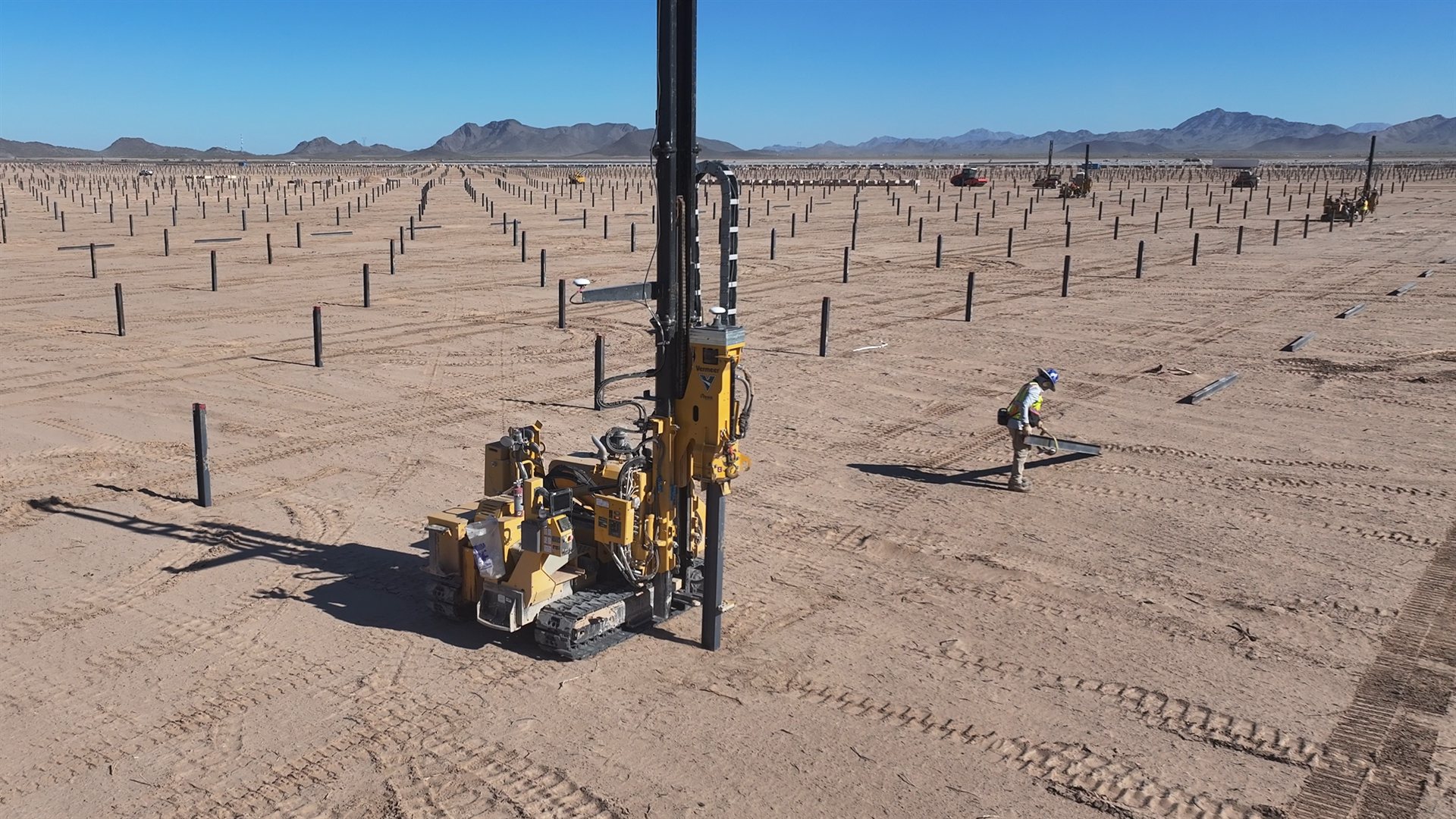
What sets Spanner's solution apart is that no new heavy equipment needs to be purchased. A device called X1 is added to machinery already operating on site, such as excavators and pile drivers, turning proven existing equipment into physical AI machines capable of autonomous work. Machine guidance first enables equipment to move precisely according to design drawings, and the system then takes the next step by automating the work itself. The company was founded by industry veterans from Doosan Bobcat, HD Construction Equipment, Volvo Construction Equipment, and Leica Geosystems.
The emphasis is on cost. Instead of buying expensive autonomous machinery, contractors can subscribe only to the functions they need, such as pile driving or grading. Because existing, proven equipment remains in use, the barrier to adoption is lower. In Korea, Spanner has supplied earthwork automation solutions to around 500 construction equipment rental companies. In the United States, it works with nine out of ten of the country's top 20 solar power plant contractors, reducing manpower for a key process on one site from four people to one. In May 2026, the company raised KRW 25.6 billion in a Series B bridge round, bringing its cumulative funding to KRW 52 billion.
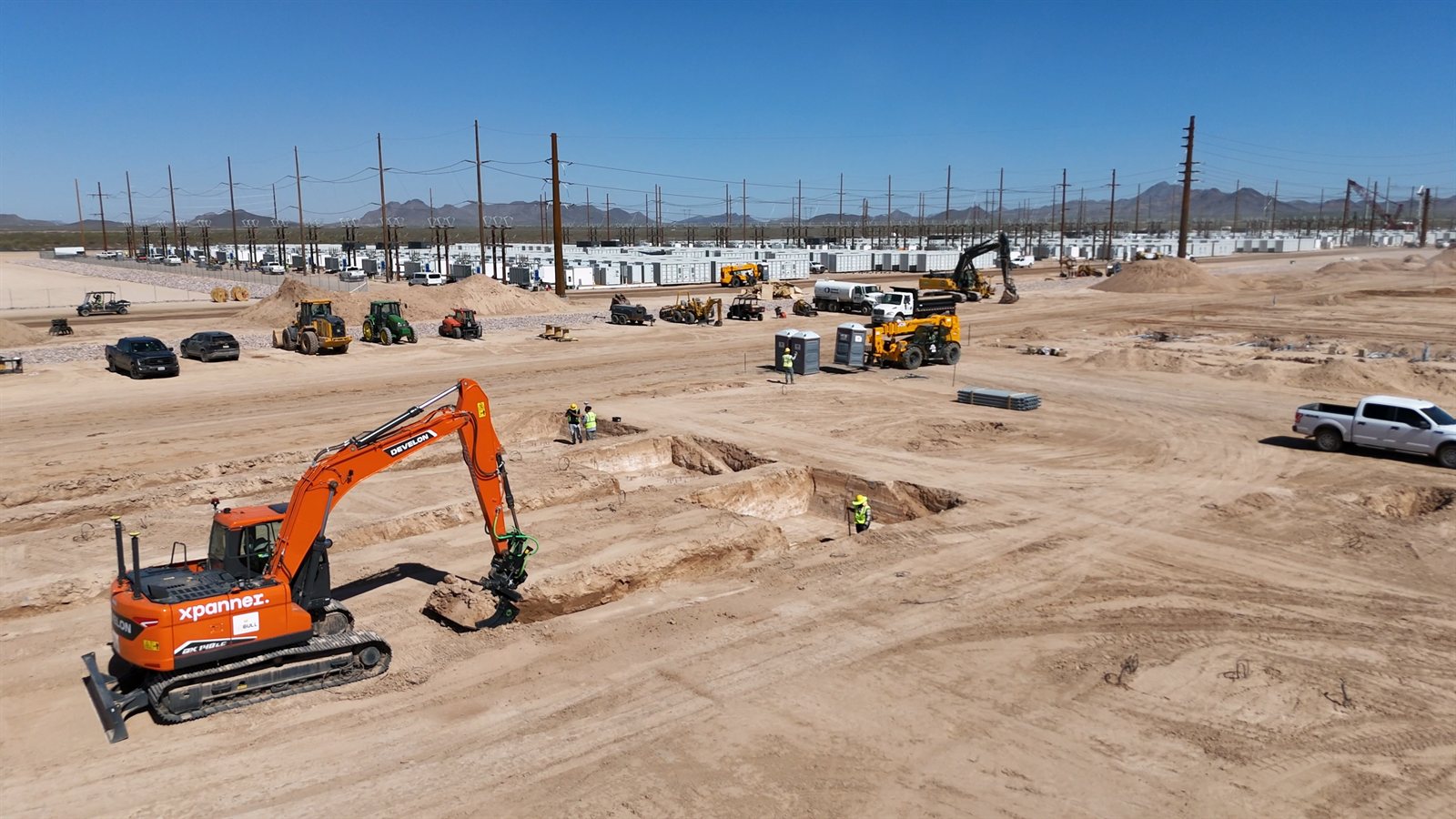
An excavator equipped with Spanner's automation technology performs earthwork at a battery energy storage system (BESS) construction site in Arizona, United States.
© Spanner
These startups have one thing in common: many of their founders and engineers came directly from construction sites. The people who saw the problems most closely are now using technology to solve them.
Where Robots Step In, Where People Step Up
In the end, this story is about people. When robots enter construction sites, do jobs disappear? In the short term, it is true that demand for labor in certain processes will decline. But a closer look at what is changing on site reveals a different picture.
Everywhere robots appear, new roles emerge alongside them. Someone has to analyze Spot's inspection data, plan the path of a floor-finishing robot, remotely operate an exterior painting robot, or supervise material robots running through the night. New jobs are emerging around operating technology and interpreting data. Workers are moving down from dangerous positions and into roles that require judgment.
It will take time before this transition reaches every construction site equally. Most of the robots introduced so far are concentrated at major contractors and their large projects. Yet around 60% of construction accident deaths occur at small sites with project costs below KRW 5 billion. In the first quarter of this year, that figure rose as high as 74%. In other words, the places that need robots most urgently are still largely outside their reach.
For smaller contractors, more realistic starting points include renting robots instead of buying them, sharing a single machine across multiple sites, or bundling equipment with operator training and maintenance support. The government's growing emphasis on field demonstration and support for smaller technology companies within its smart construction R&D programs is also intended to close this gap. The next challenge is to bring initial costs and operational burdens down to a level that smaller firms can realistically absorb.
Construction sites in 2026 are in a transitional period in which humans and robots coexist. If the places robots have taken over are places where no person should have had to go in the first place, that alone is a meaningful beginning. The essence of smart construction is not simply bringing machines onto the site. It is redesigning where people should be.
Robots for dangerous places, people for decisions. Automation on the construction site is not the disappearance of jobs, but a redistribution of roles.