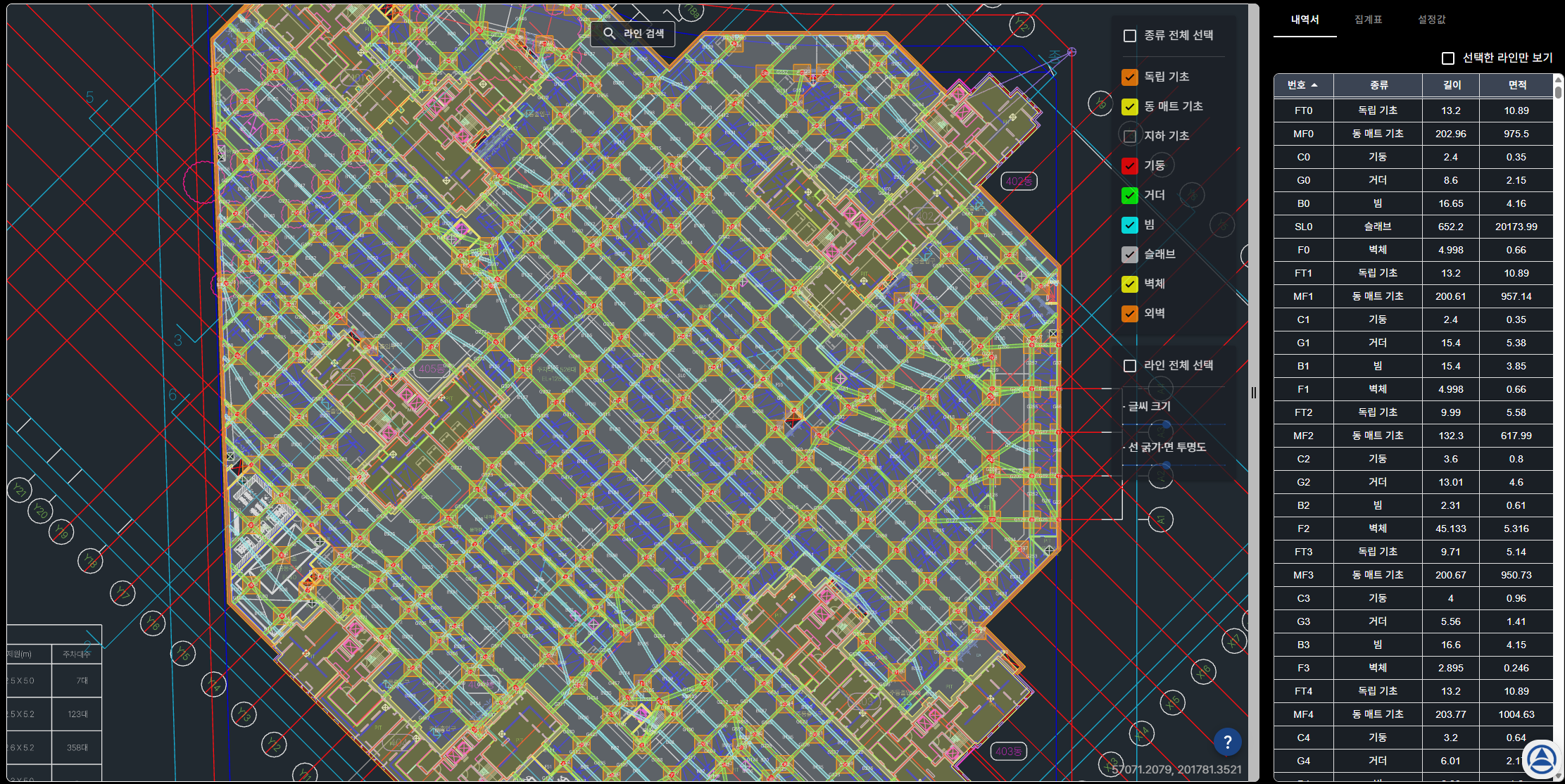
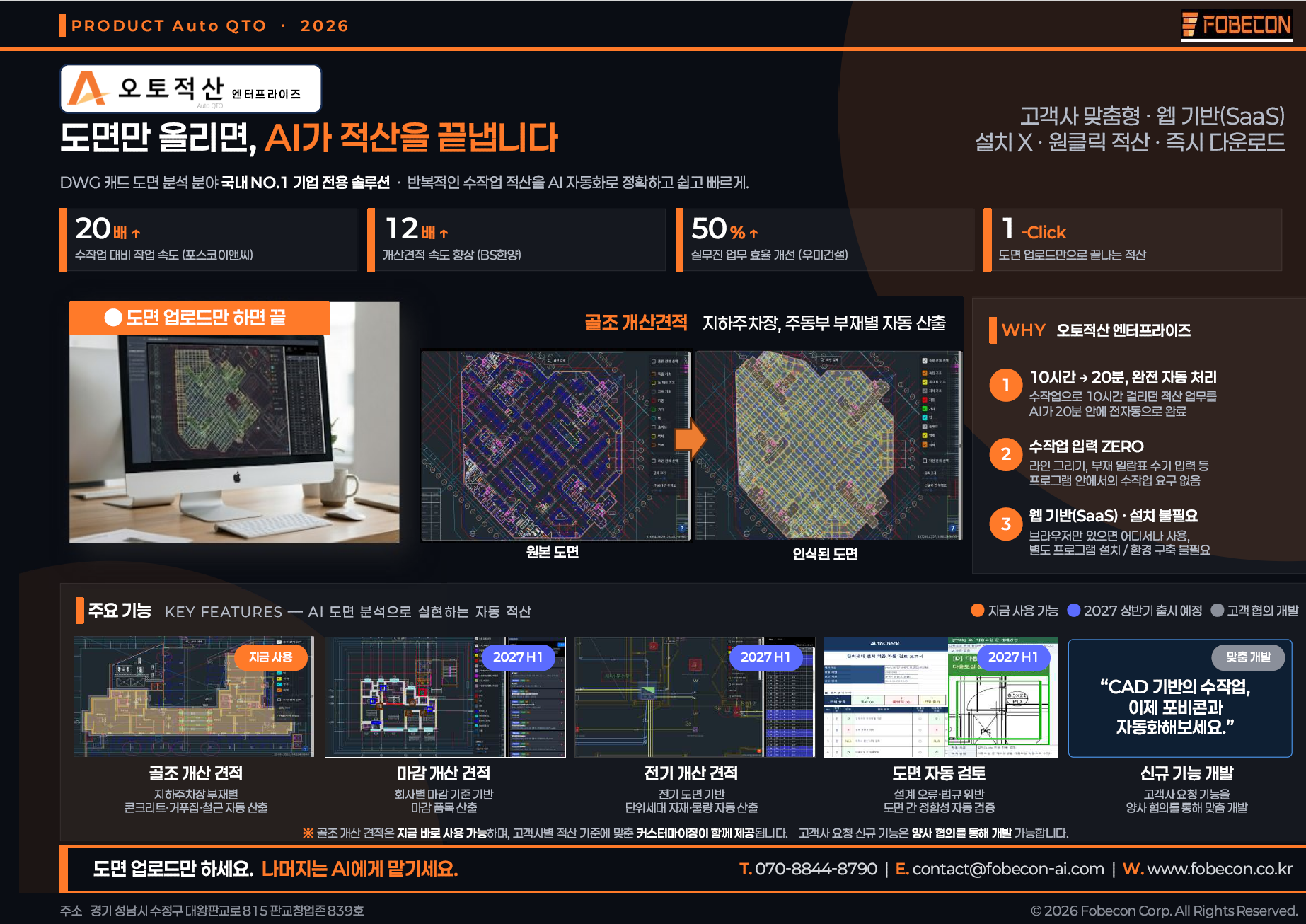
FOBECON reads lines, hatches, text, and layers directly from original DWG files at the object level, without converting drawings into images.
Source · FOBECON
Is a Drawing an Image or Data?
FOBECON is not the only company pursuing automated quantity takeoff. The real difference lies in how the drawing is read. Many competitors convert drawings into images and analyze them much like the human eye does, estimating lines and text from pixels. FOBECON, by contrast, opens the original DWG design file directly. Because it reads lines, hatches, text, and layers as individual objects, it does not have to estimate where a wall begins or ends — it retrieves the design data itself. Read a drawing as an image and you get an approximation. Read the original data and you get the design itself. FOBECON has combined this approach with more than one million training data points processed from over 20,000 real-world drawings to build an AI model specialized in quantity takeoff.
Reading the original data brought more than speed. What surprised users most was the precision. Auto Takeoff even identified items that had been missed in manually prepared quantity sheets. In a field where a 1% error in accuracy can translate directly into loss, that result carries weight.
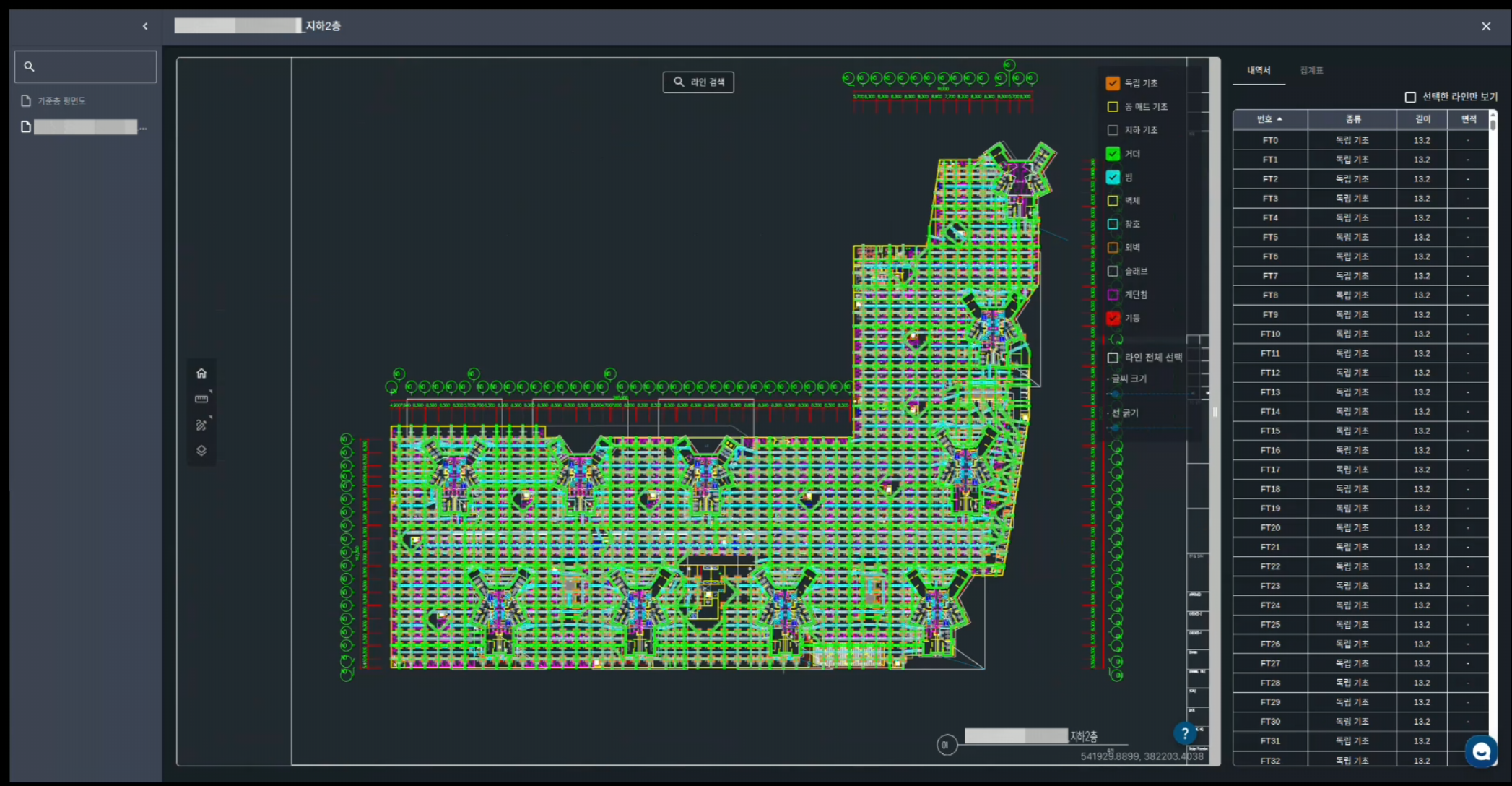
Structural quantities for components such as columns and beams automatically calculated from an underground parking garage drawing.
Source · FOBECON
Columns and beams recognized as individual objects in the same drawing. Quantities can only be calculated once each component is identified.
Source · FOBECON
Building the AI by Building the Data
Technology alone did not open the market. In the conservative construction industry, the first question is often not how good the technology is, but where it has already been used. That made winning the first customer especially difficult. FOBECON reversed the order. Instead of selling a finished product first, it began by providing quantity takeoff as a service, accumulating more than 65 real drawing sets from 30 jobsites. It did not sell the technology first; it built a body of drawings and trained the AI on top of them. Beginning with POSCO E&C, the company gradually secured references from major contractors and built a ladder of trust.
FOBECON won the Grand Prize at the 2025 Hoban Innovation Technology Competition. Since then, it has been carrying out a proof of concept (PoC) at Hoban Construction sites and jointly developing features such as PL window recognition and early-stage work quantity calculation. In its own verification tests, the company recorded quantity takeoff accuracy of more than 95% and reduced takeoff time to one-tenth of the previous level. More recently, it secured follow-on Pre-A investment from a Ministry of Land, Infrastructure and Transport fund, further strengthening its position in the industry.

Joong-seok Song
CEO, FOBECON
Song founded FOBECON in 2024 to solve inefficiencies in construction drawing analysis with AI. While working on image recognition technology, or vision AI, at Koh Young Technology's Machine Vision Research Institute, he heard from a construction professional that quantity takeoff for a single trade could take four weeks. That led to a simple starting point: "A 2D drawing is ultimately an image, too." Song holds a Ph.D. in Computer Software Engineering from Hanyang University.
fobecon.co.kr →Construction was not your field of study. How did you discover this problem?
At my previous company, I worked with vision AI in machine vision, unmanned retail, and fashion. Then someone I knew in construction told me, "To calculate quantities for just one brickwork trade, we measure the length and height of hundreds of walls on a drawing with a digital ruler and manually enter tens of thousands of lines of formulas. It takes four weeks." When I looked at the drawings myself, I found that companies were really spending more than KRW 2.5 million per trade just to have people measure them manually.
"Isn't a 2D CAD drawing ultimately just an image?" With that thought, our CTO and I built a prototype over a holiday and tested automated wall-area calculation. A task repeated tens of thousands of times was completed in just a few minutes. That moment became the starting point for FOBECON.
In this field, even millimeter-level errors can lead directly to losses. How did you achieve that precision, and what surprises clients most?
The key is our technology architecture, which processes the original DWG data directly. Unlike competitors that convert drawings into images for analysis, we integrate and analyze the lines, hatches, text, and layers in the original DWG file and recognize them at the object level. On top of that, we built a quantity-takeoff model using more than one million training data points processed from over 20,000 real-world drawings.
What surprises customers most is that we achieve both speed and precision. At POSCO E&C, a quantity takeoff process that previously took 10 hours was reduced to 20 minutes, while millimeter-level comparison verified 99.9% accuracy. At BS Hanyang, uploading a residential unit floor plan produced quantities for around 150 finishing items in just two minutes. In particular, Auto Takeoff even caught items that had been omitted from manually prepared quantity sheets, leading customers to say it was "more precise than a person."
Is automated quantity takeoff also changing the role it plays for contractors and architects?
Automated quantity takeoff is moving beyond being simply a "time-saving tool" and becoming core infrastructure that improves both estimate accuracy and decision-making speed. General contractors used to rely on data-based estimates because bids often had to be submitted within two weeks. Now they can produce precise estimates close to actual cost as soon as they receive the drawings, using the technology as a strategic bidding tool to improve their chances of winning projects.
Architecture firms can reduce their dependence on outsourced takeoff services and cut costs, while specialty contractors can independently verify errors in quantity sheets and drawings, preventing losses from incorrect progress-payment claims. Precise quantity data also helps optimize material orders and assess the impact of design changes, leading to secondary benefits such as fewer construction-cost disputes and claims, and more stable cost management.

The FOBECON team in Pangyo. They were together through the early period when the company built its drawing database through quantity takeoff services.
Source · FOBECON
What advice would you give to younger founders considering a startup in construction or architecture?
Keep in mind that construction has "huge demand for digital transformation, but even greater conservatism." There are certainly many worthwhile problems to solve, but persistence in building real-world data and references matters before the technology itself. Do not get carried away by a single PoC. Approach the market with the mindset of building a ladder of trust, one rung at a time.