For a long time, flooring was simply something laid underfoot. The grain of the wood, the feel beneath your feet, ease of maintenance — the criteria for choosing flooring largely began and ended with the floor itself.
That is beginning to change. As consumers become more discerning, more people are looking for spaces where floors, walls, and furniture feel connected rather than designed separately. The result is a finish in which boundaries are less pronounced and one surface flows naturally into the next — what is known as 'seamless' design. Whether through laying a single large slab of stone or creating an uninterrupted surface with a finely applied coating, this kind of continuity has long been achievable only with expensive materials and highly skilled workmanship.
Now a flooring company is approaching that continuity in a different way. The three products Gujung Maru will present at the upcoming KOREA BUILD — Tone-Up Edge, which refines the sides of tile flooring; OVE WALL, a wall panel designed to align with the width of the flooring; and LAYERS, an interior film that carries flooring colors onto other surfaces — are used in different places, but they all do the same thing: erase the boundaries between surfaces. And they do so by building the solution into the product, rather than relying on craftsmanship at the jobsite.
One Job, Three Products
Gujung Maru groups these new products under the idea of 'seamless design.' Rather than referring to a single product, it is an approach to space in which floors, walls, doors, moldings, and films connect naturally through tone and texture. Put another way, the goal is to make the seams between the many surfaces that make up a space less visible.
When those seams disappear, a space looks larger and more composed. The more fragmented the surfaces are, the more often the eye is interrupted; the fewer the boundaries, the more the space reads as a single whole. Much of what we perceive as a sense of refinement comes from details like these. The problem is that eliminating those seams has traditionally been left to the jobsite. Using large-format materials, minimizing joints, and matching colors across different materials are all notoriously expensive and difficult to execute.
Gujung Maru has taken almost the opposite approach. It incorporates the work of minimizing seams into the manufacturing process itself, making it possible to create continuous surfaces without requiring exceptional craftsmanship on site. These three products demonstrate that approach across the floor, the wall, and the surfaces beyond.
Erasing the Gaps in the Floor — Tone-Up Edge
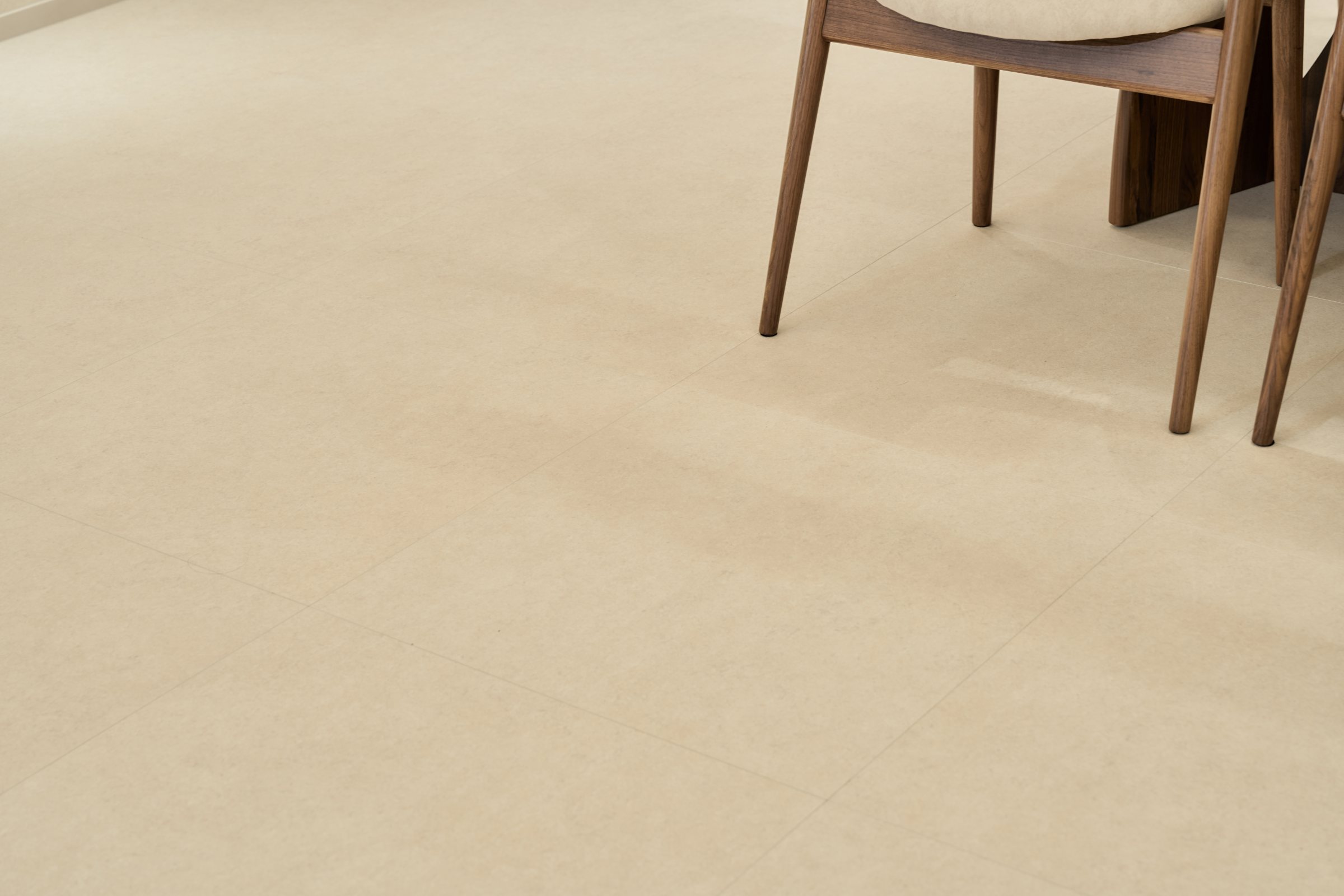
When tile-format flooring is installed, fine gaps remain between each plank or panel. From above, you see the color of the flooring, but the exposed edges visible through those gaps are often left in the material's natural base color. When those subtle differences appear across the floor, the surface can ultimately look like a collection of separate pieces fitted together.
Tone-Up Edge is a finishing process that colors those exposed edges to harmonize with the surface. By applying a similar tone to the sides of the flooring, it reduces the color difference visible through the gaps and softens the boundaries between individual pieces. It is different from tile grout. Rather than filling the gap itself, it matches the color inside the gap. On light white or beige flooring, this creates cleaner-looking boundaries; on darker flooring, it softens the contrast of the lines dividing each piece.
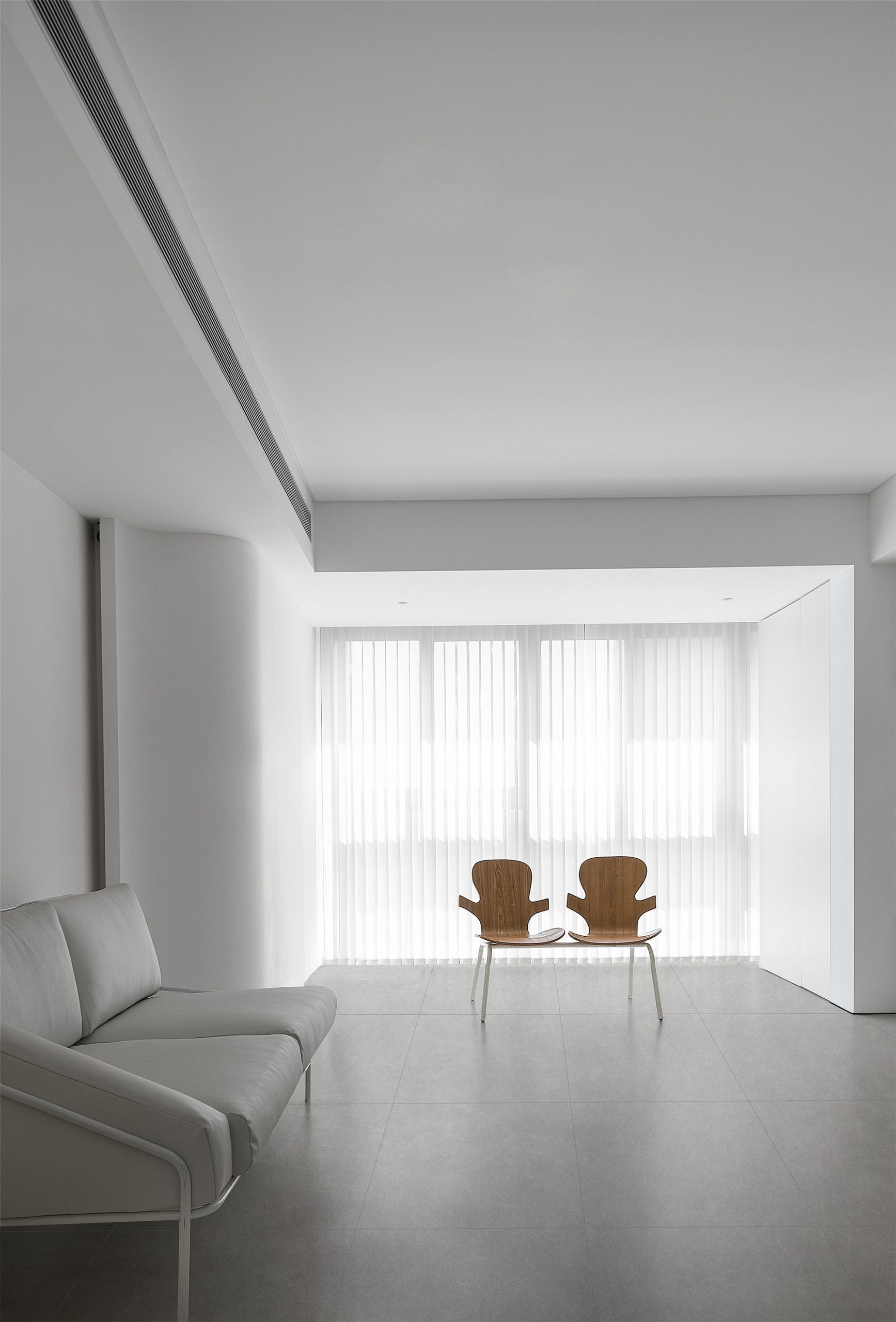
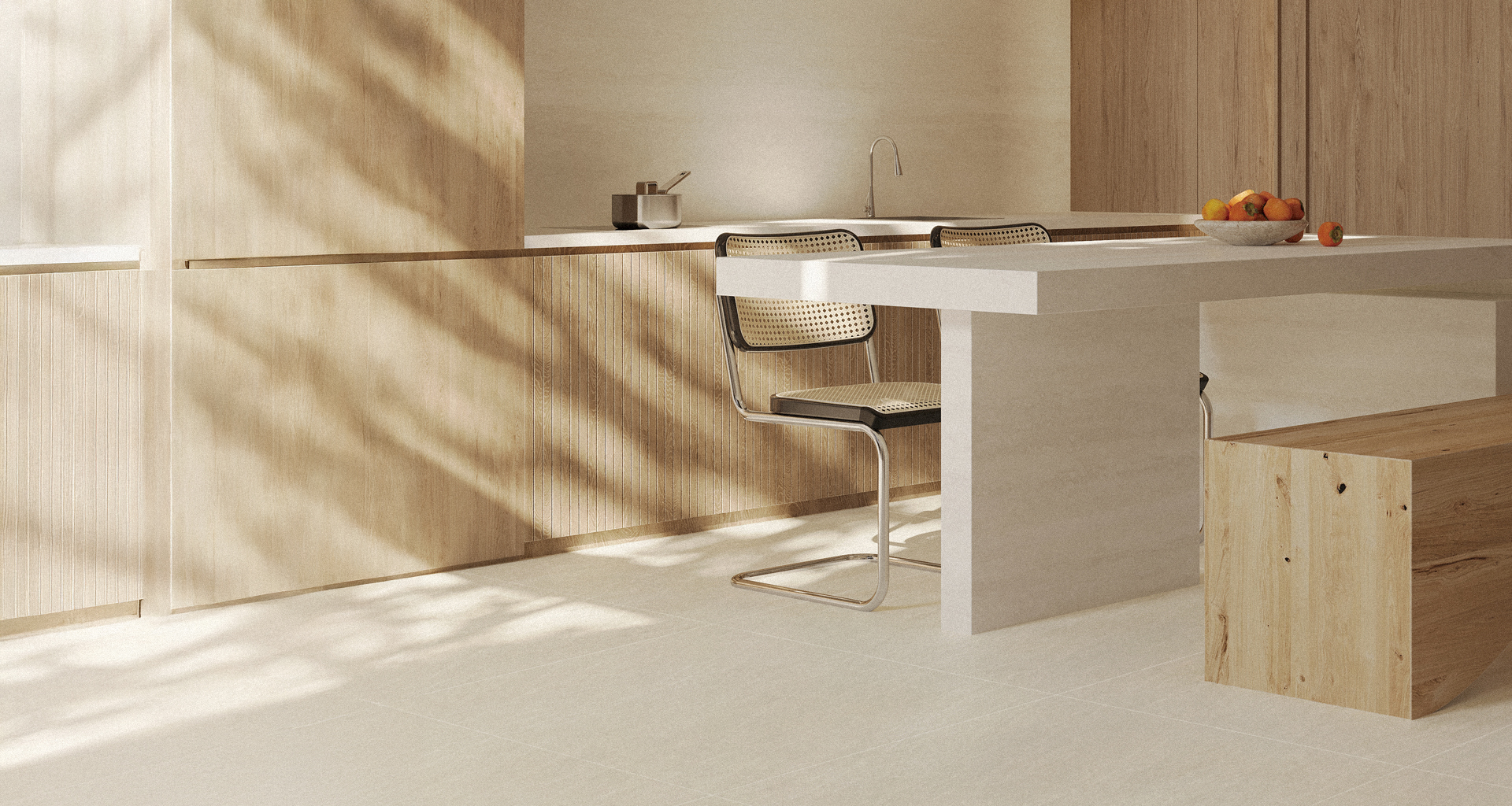
Tone-Up Edge was originally offered as an optional detail for Gujung Maru's marble flooring line, 'MARBULOUS ZEN.' This time, it comes as a standard feature on its successor, 'MARBULOUS L.' What was once a nice-to-have option is now built in from the start, bringing the detail to a wider range of consumers.
Carrying the Floor Lines Up the Wall — OVE WALL
Once the seams within the floor have been softened, the next boundary is where the floor meets the wall. This is where a space is usually interrupted again, because the lines of the flooring and the lines of the wall finish are typically arranged independently of one another.
OVE WALL aligns those lines. The key is its width. OVE WALL panels are the same width as MARBULOUS flooring, allowing the joint lines on the floor to continue directly up the wall. A double-width OVE WALL panel is also available, corresponding to the width of two MARBULOUS flooring panels. The result feels almost as if the flooring has been folded upward onto the wall, placing the floor and wall on a single continuous grid. The panels connect using a tongue-and-groove (T&G) system, with the spacing at the joints reduced to as little as 0.6 mm. It is another design choice aimed at making seams on the wall as unobtrusive as possible.
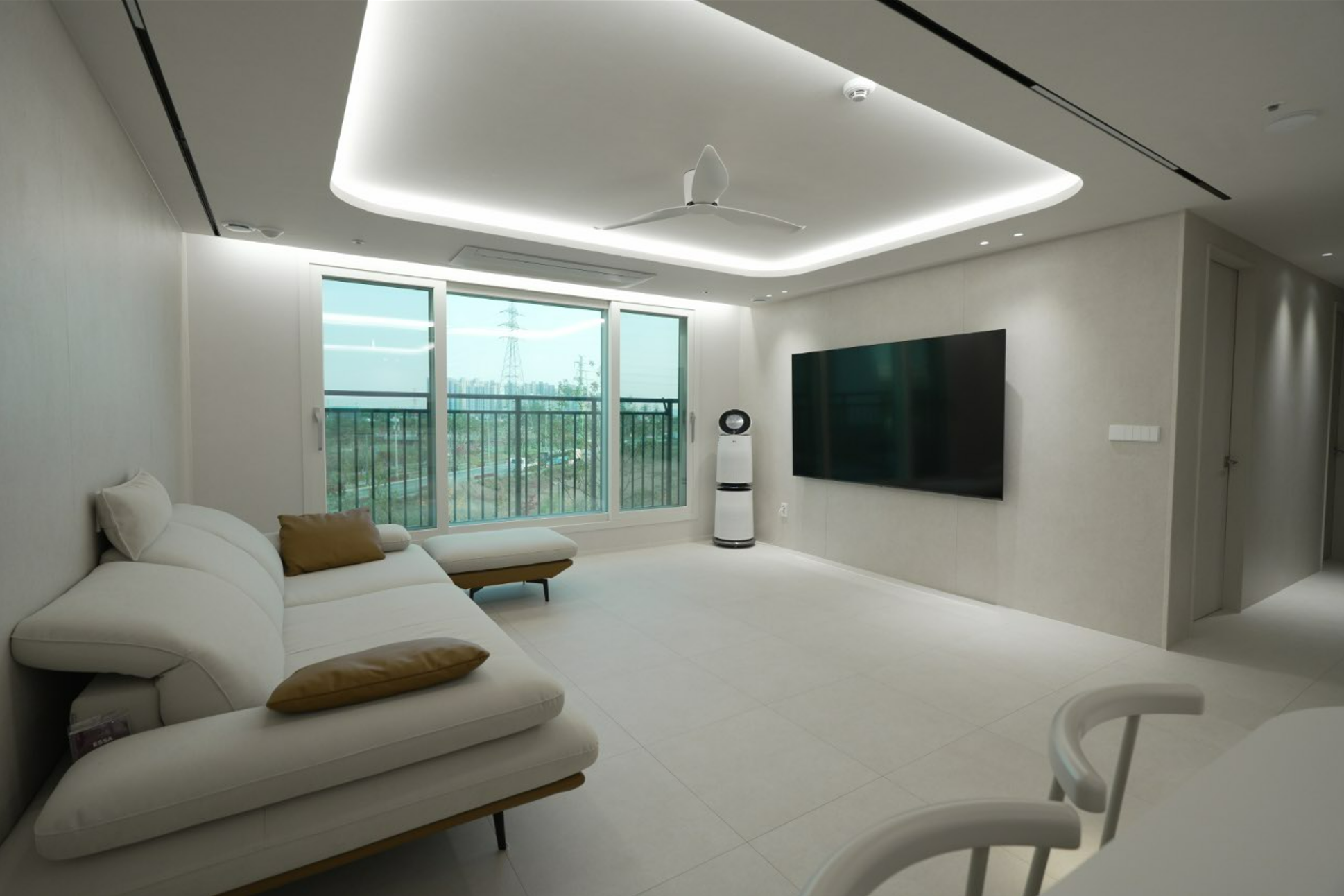
The surface comes in marble-inspired patterns that recreate the texture of stone. Gentle Fantasy, Moroccan Cream, and Warm Breeze have each been coordinated with complementary flooring colors, making it easy to carry the tone chosen for the floor onto the wall. Gujung Maru's head of design offered the same perspective when describing OVE WALL: "Rather than looking at it as a standalone product, see it in combination with the flooring, film, and molding." The value of the product does not lie in the wall alone; it becomes clear when the wall connects with the floor.
Carrying Tone from Surface to Surface — LAYERS
Even if the floor and wall are aligned, a space can quickly become fragmented again when the doors, furniture, and moldings all use different finishes. Interior film fills this final gap.
LAYERS is an interior film collection designed to complement or match the colors of Gujung Maru flooring. It was created to carry the color that begins on the floor across doors, furniture, walls, and moldings, bringing the entire space together in a single tone. Around twenty designs are available across solid, wood, and stone categories, with matching moldings in the same designs also planned for release.
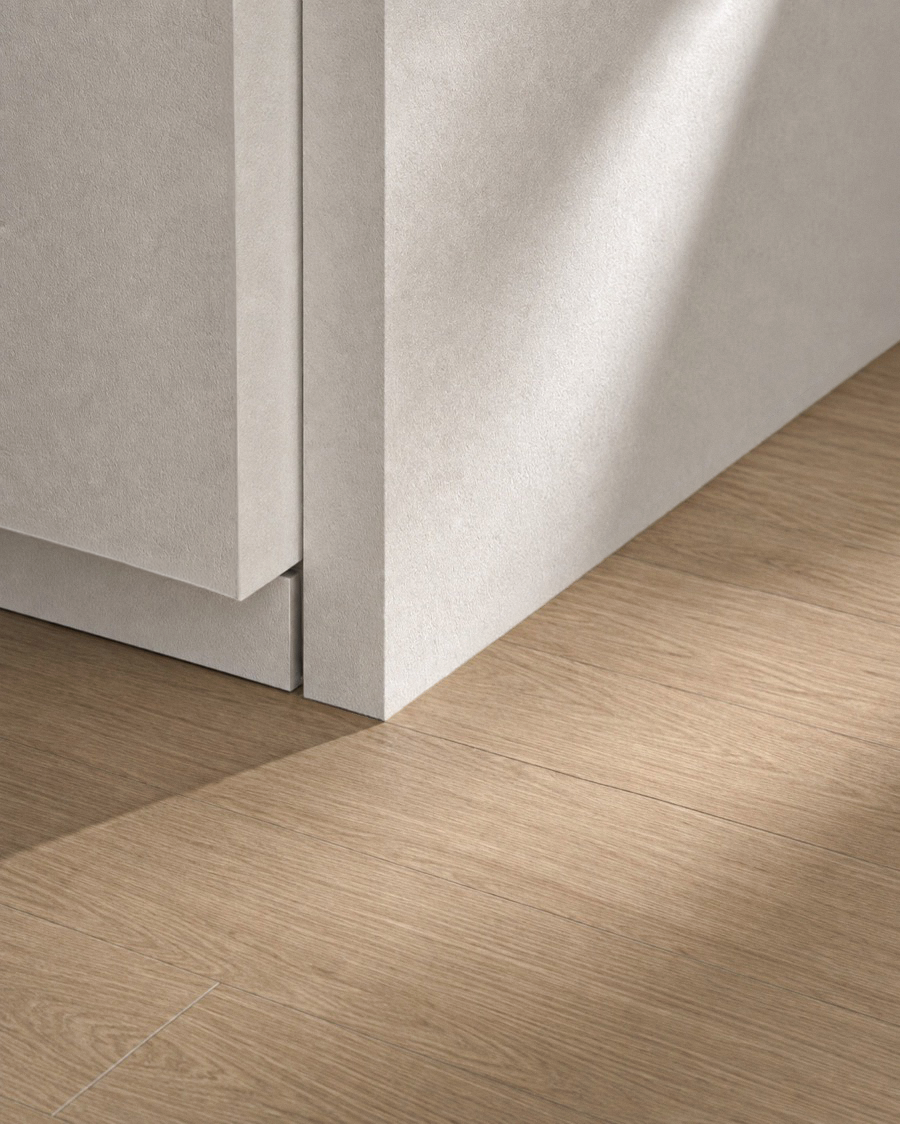
With interior film, the quality of installation can determine the quality of the finished result. If air bubbles remain beneath the film, even the best color can look poorly finished. LAYERS uses an air-release adhesive system designed to make trapped air easier to remove, helping installers achieve a smooth surface on site. It is a product that transfers the know-how accumulated through flooring manufacturing onto the thin surface of an interior film.
Control Color and Texture, and the Space Gains Refinement
Placed side by side, the three products reveal something clearly. They may belong to different categories — flooring, wall panels, and film — but all three are fundamentally about working with 'surfaces.' Tone-Up Edge applies color to the sides of flooring, OVE WALL coats panels with the texture of stone, and LAYERS transfers the colors and grain of flooring onto film. Each product ultimately comes down to the same question: what color and texture should be placed on a surface, and how?
It is work Gujung Maru has been doing for a long time. The company began as a building-materials distributor in 1988 and started manufacturing flooring itself in 1998. Since then, it has handled the entire flooring production process — selecting wood, bonding, coating, and machining — while building a portfolio of nearly two hundred products across engineered flooring, tile flooring, natural-wood flooring, and solid-wood flooring. The ability to create precisely controlled surface colors and textures sits at the heart of that accumulated expertise.
Seen from that perspective, wall panels and interior films are less a sudden departure than an extension of technologies refined through flooring onto other surfaces. It also provides a basis for judging the potential of these new products. Gujung Maru is not stepping into an entirely unfamiliar field; it is simply moving what it already knows how to do from floors to walls and furniture.
What Comes After the Boundaries Disappear
Until recently, seamless interiors were largely reserved for those able to afford large-format materials and labor-intensive installation. Gujung Maru's three products bring that sense of continuity into the products themselves, allowing tones to flow from floor to wall and from wall to other surfaces without requiring exceptional workmanship. As consumers' expectations rise, the means of meeting those expectations are moving from costly materials and specialized installation into the products themselves.
Flooring began underfoot. Now it climbs the wall and extends onto furniture. How far that line can continue will be on view at the upcoming KOREA BUILD, where all three products can be seen together in one place.