You've watched the flow of cities and architecture for a long time now. How does the shape of the city we live in today look to you?
The word "function" entered the vocabulary of cities and architecture in the early 20th century, and it became the core concept that established modernism as the movement of a new era. Nineteenth-century industrialization caused an explosive rise in urban population, but the medieval city structure that had persisted until then simply couldn't handle it — polluted homes and streets became an everyday sight, and an unprecedented disease, the Spanish flu, broke out. After that catastrophe, which killed 50 million people out of a world population of 1.7 billion at the time, architects and sociologists came together and began reorganizing existing cities and architecture around function and efficiency as the key standards. But a century of competitively building cities that were dense, sealed, and tightly packed together left us facing another catastrophe we recently had to live through: COVID. And even though COVID was only a few years ago, we seem to have forgotten it and gone back to living exactly as we did before — that troubles me deeply.
So what would you say we're lacking right now?
We cannot be the owners of this world. We need to recognize that we are only guests, briefly invited in. So if there's a "deficiency" in us, isn't it exactly this — a lack of accurate awareness that we are guests of this world, and of the conduct that awareness demands?
We cannot be the owners of this world. We need to recognize that we are only guests, briefly invited in.
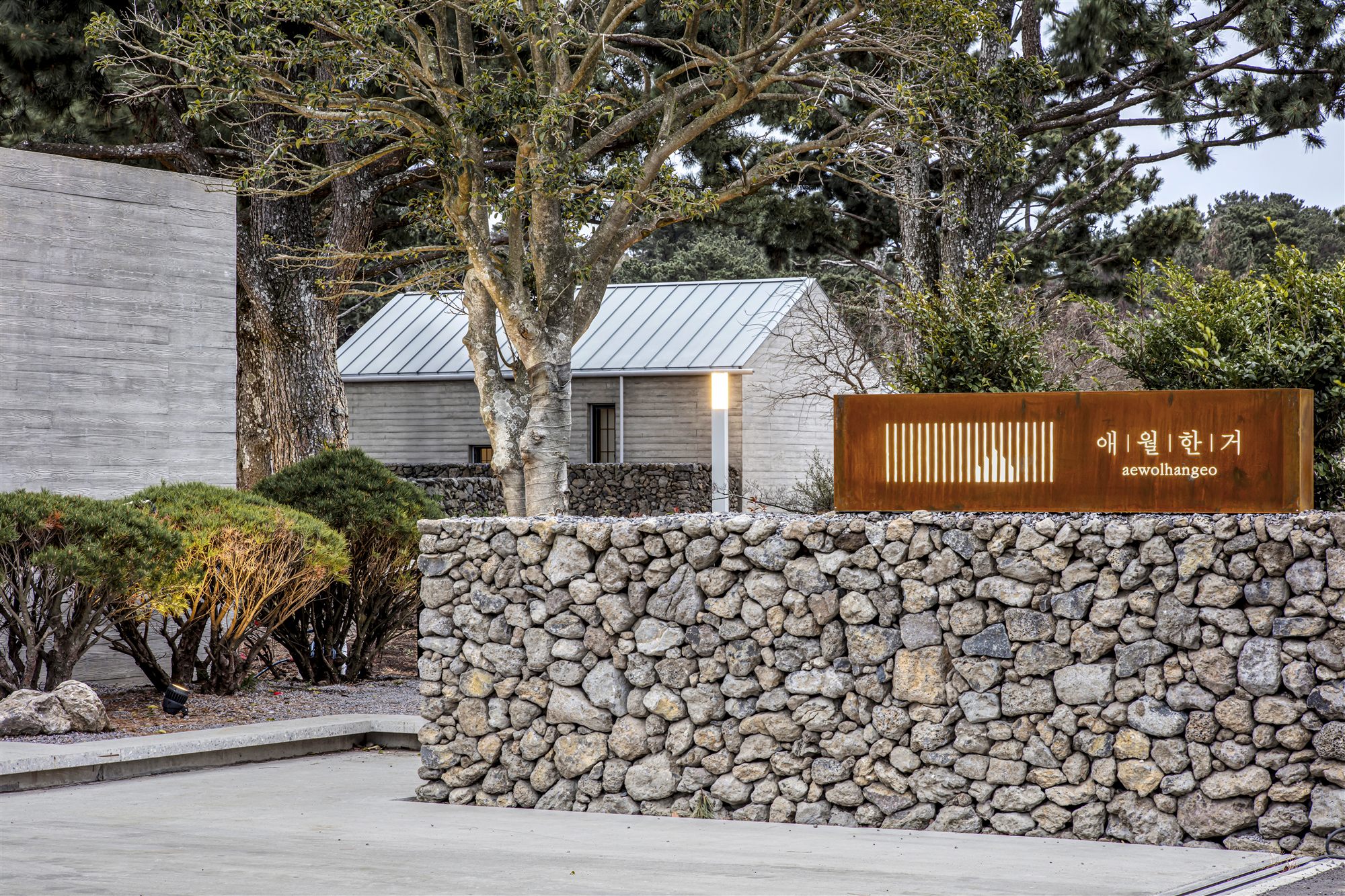
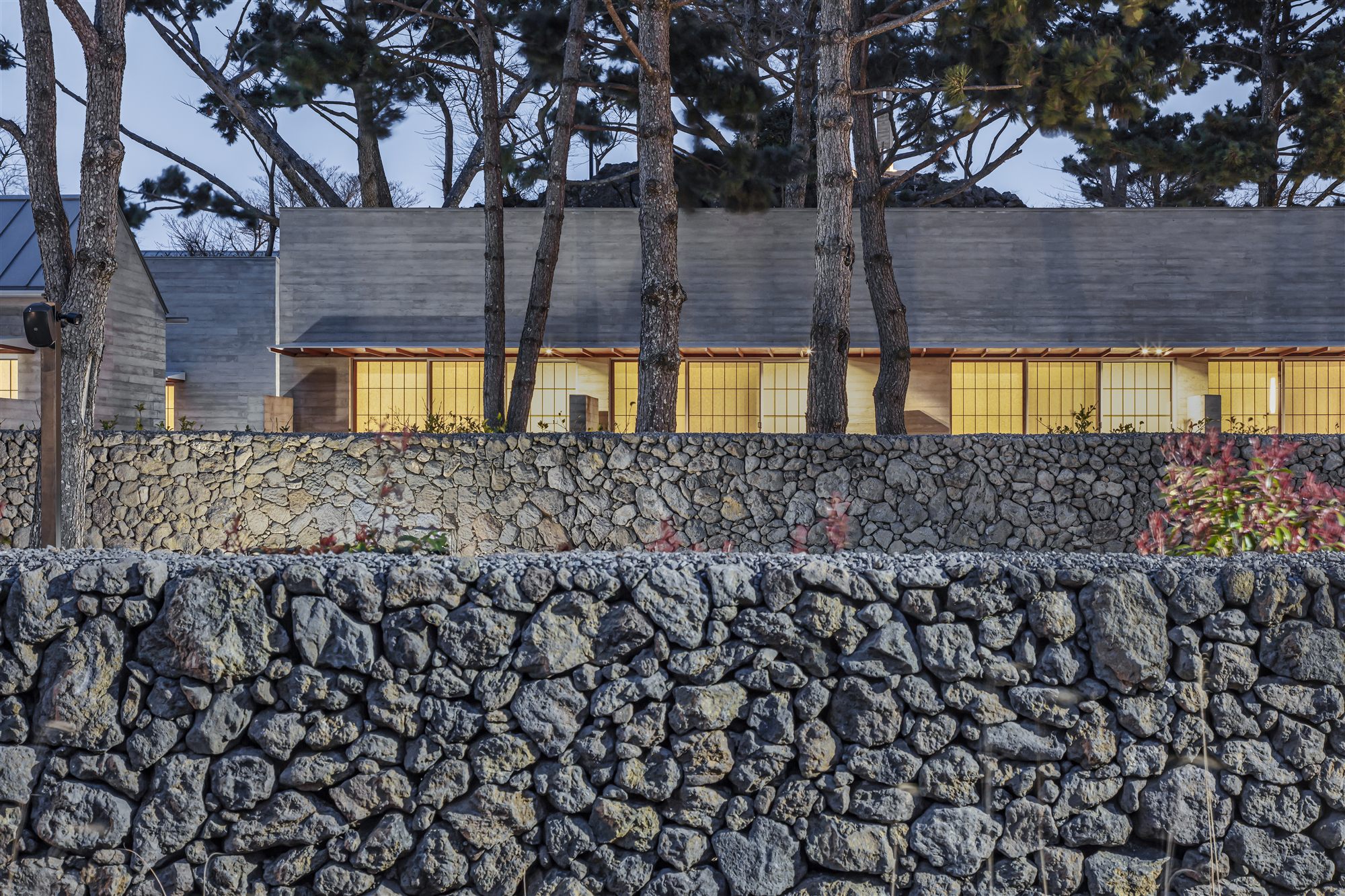
A Corten steel sign hangs over a basalt stone wall. Jeju's land comes first; the architecture is placed carefully on top of it.
© JongOH Kim
Could you introduce a project that carries this way of thinking?
One project built on this idea is a small stay called Aewol Hangeo on Jeju Island. On this site, 45 old pine trees had already been the true owners of the land, and it seemed clear they would continue to be. Given that, I felt that whatever we built here now had a responsibility to make their sovereignty even more evident, and that's the work that resulted. Here, we, as the guests, stay for a while, then return to the world again, carrying the strength of this land and of the pine trees that have lived here for so long.
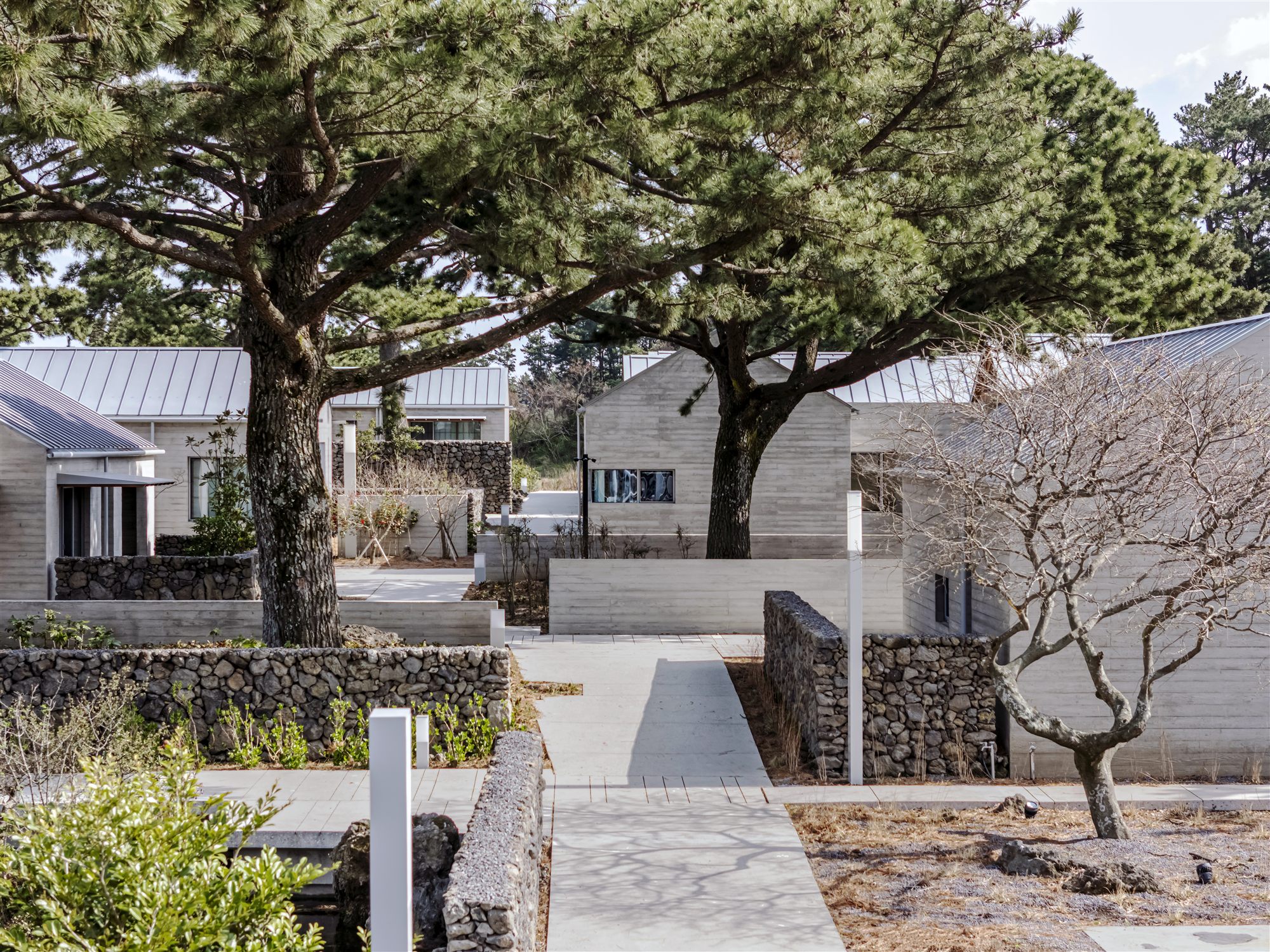
Forty-five old pine trees are the true owners of this land. The architecture was split apart to sit among them, making their sovereignty even clearer.
© JongOH Kim
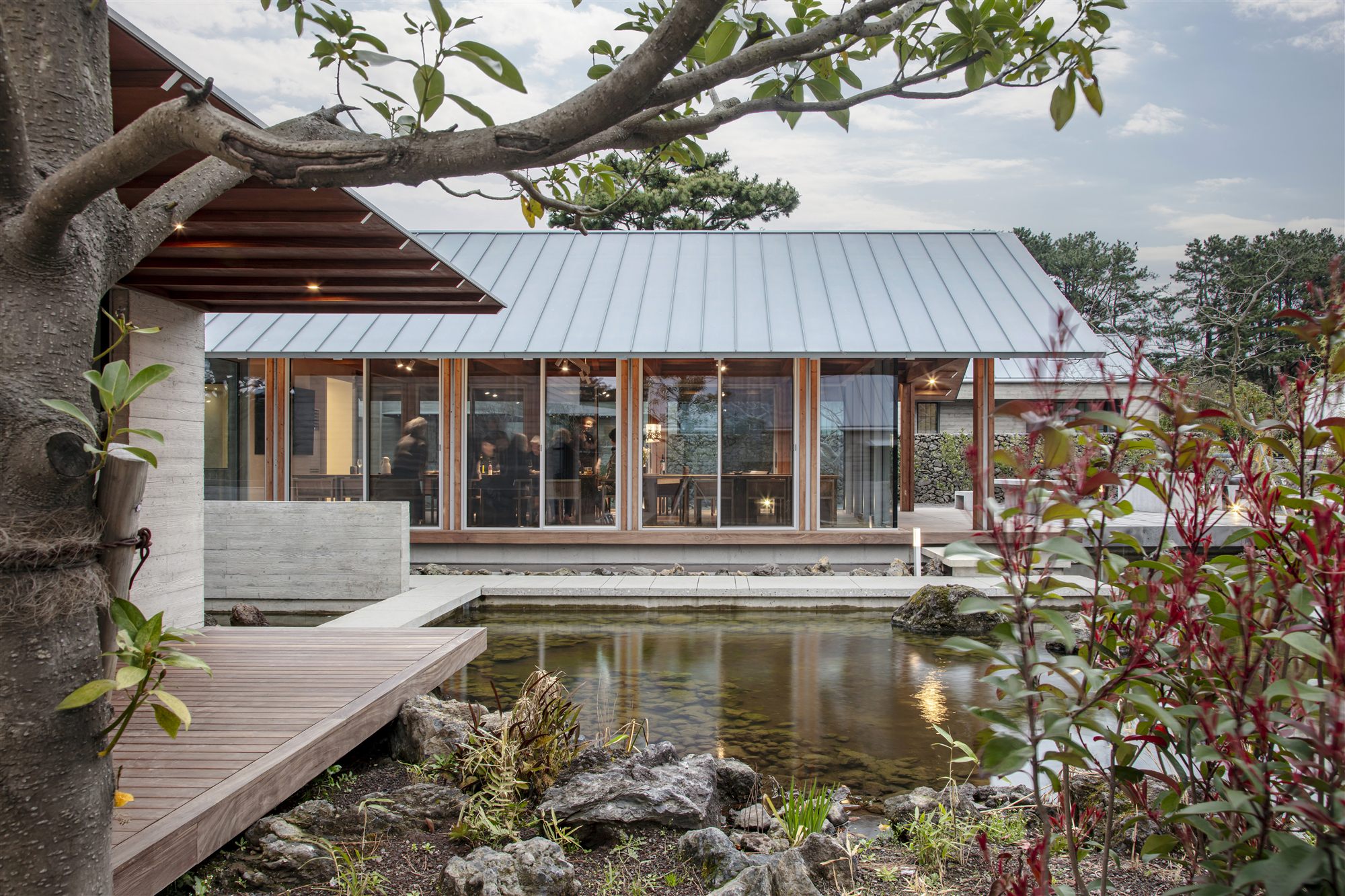
Beyond the glass wall, water and garden unfold in front of the living room. The guest stays a while, then returns to the world carrying the strength of this land and its old trees.
© JongOH Kim
What do you think a space can give a person?
What we need now, rushing through life the way we do, is probably genuine rest. The Chinese characters for "rest" (休息) mean being beneath a tree and gaining freedom of mind. That's what it means to step away from the curse of mammon and restore a spirituality in us that's on the verge of dying out.
Long ago, we lived our daily lives under the influence of many different spirits. There was a guardian spirit of the house site, a hearth-and-home spirit in the main living-room floor, a kitchen spirit, even a spirit in the outhouse, and a spirit believed to live at every threshold — so people lived carefully and with restraint at all times. At the entrance to a village stood a shrine and a shrine tree, and people prayed for the community's wellbeing every time they passed through. But in the last century, one god suddenly appeared and drove all of them out — Mammon. This powerful god of wealth pushed us faster and packed us tighter, driving us into endless competition, and as a result, Korea became one of the best-earning countries in the world — while at the same time becoming a land of despair with the highest suicide rate anywhere. The architecture I designed within Suyuwon was built with exactly this purpose in mind, but even setting that specific purpose aside, I consider building this kind of space, even in everyday architecture, to be a duty placed on me.
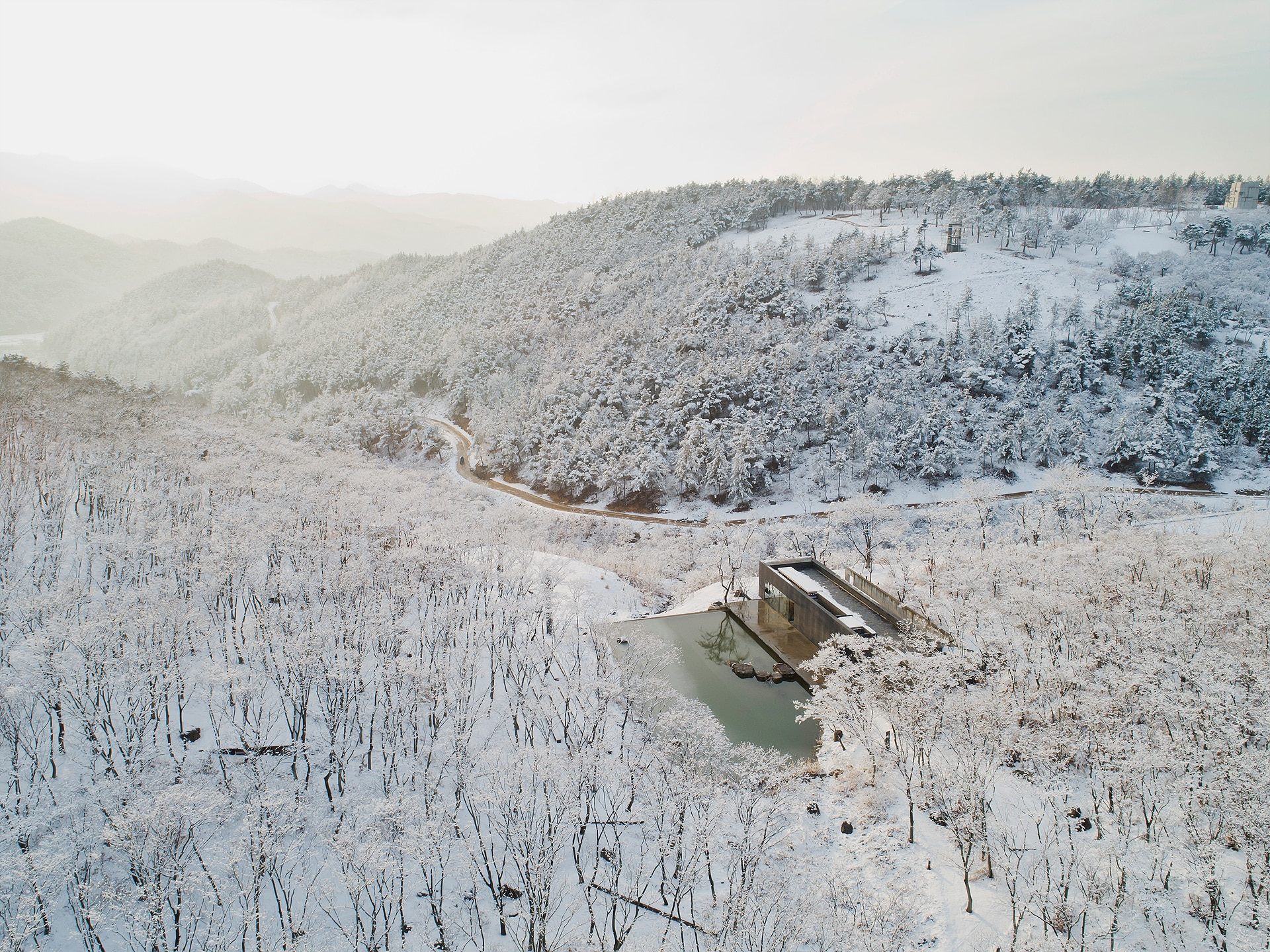
Sadam, set beside a pond deep in snow-covered mountains. Built as a space to step away from the curse of mammon and restore spirituality.
© JongOH Kim
So what, to you, makes for good architecture?
Good architecture isn't famous architecture that draws attention through some unusual appearance for the sake of its own existence — it's architecture that exerts a good influence on the people around it and shares something with them. That matches exactly what David Harvey meant when he said "not aesthetics, but ethics."
Architecture, at the very least, only has grounds to exist as a profession for the sake of that kind of good will. And I believe the title of "architect" can only be earned through that.
Welcomm City comes to mind. I heard that at the time, you also considered the view that would be seen from the village behind the building, beyond the client. What led you to make that choice?
Architecture necessarily occupies a piece of land in order to exist. For that reason alone, architecture cannot escape the obligation of public value — of publicness. Every piece of land is unique, existed before the architecture arrived, and will continue to exist afterward. A building owner only ever holds temporary possession of that land, or even of the building they've constructed on it, and as long as that land and that building connect to and affect the land next to it, they cannot betray the value of publicness. Otherwise, we would be violating the common good of the very society we agreed to join by promising to follow its rules — and if enough architecture does that, that society is bound to fragment and, eventually, collapse.
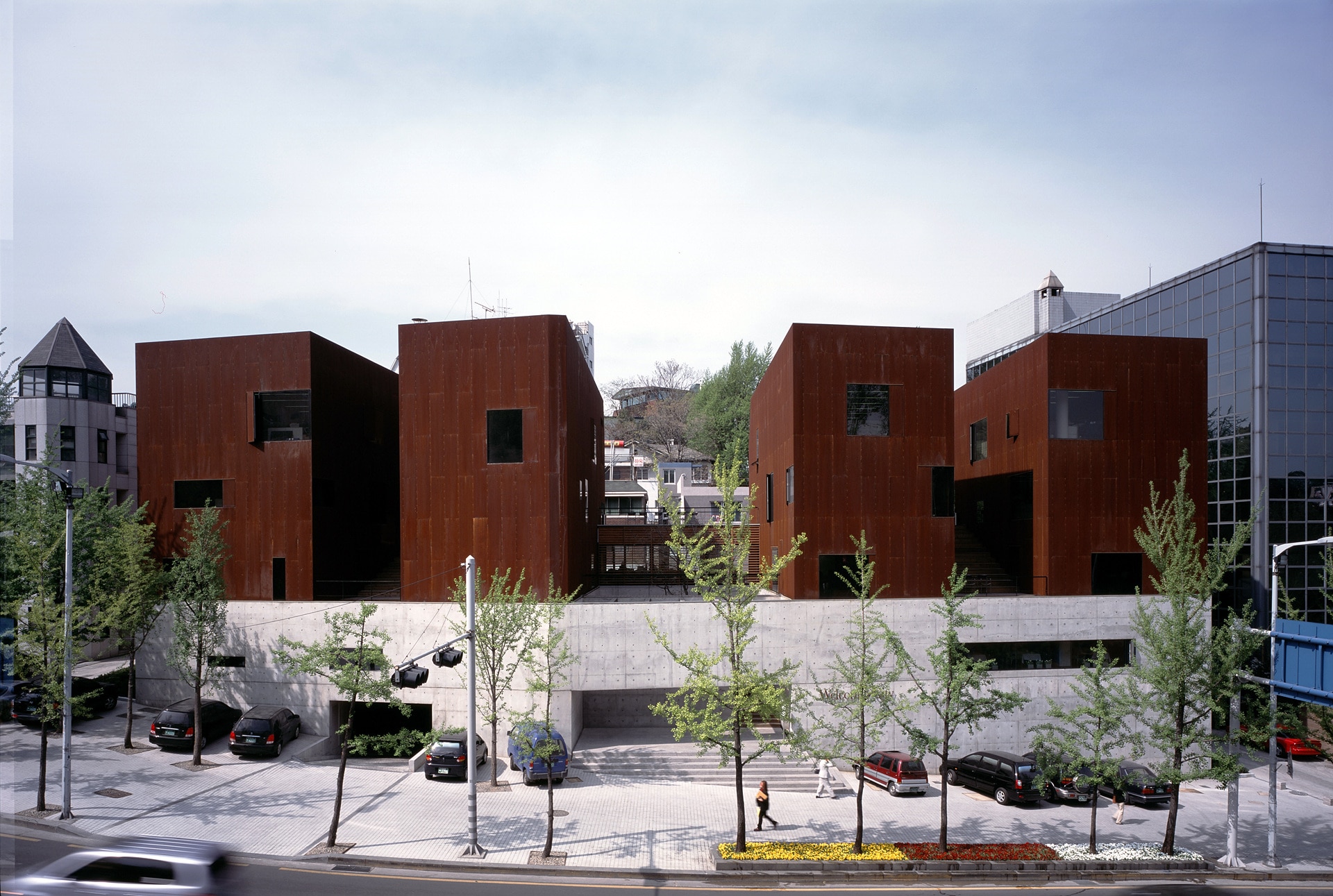
Welcomm City. Four Corten steel masses sit apart across the land. Architecture takes on the obligation of publicness the moment it occupies a piece of land.
© Osamu Murai
There's frequent talk about how difficult the reality facing young architects in Korea is right now. From the perspective of someone who's been in this work a long time, how do you see them?
Jik (職, occupation) and eop (業, vocation) are different words. The character jik itself means the act of doing work someone else has ordered — it corresponds to the English "Occupation," a state of being occupied. Eop, though, is the form of carrying out work you've received from heaven — a state of having been called, which is what the English word "Vocation" (from Vocare) captures, as I understand it. Put another way, jik is work you do because you were told to — a mission handed down (使命); eop is work you do because you were called to it — a calling (召命). That's why you can step down from a jik by resigning (辭職) or be suspended from it (停職) and walk away, but to give up an eop, you have to strike (罷業) or shut it down entirely by ceasing operations (廢業).
An architect can think of their profession as a jik or as an eop. Whether you're at a large corporate firm or a small design studio, deciding how you regard your profession — as jik or as eop — is entirely your own choice to make. And once you've made that choice, the two kinds of architect end up living genuinely different lives.
These days, AI produces architectural drawings and forms in an instant. How do you view this change?
AI is always decisive. It's fast, definitive, and never hesitates. But is a life without hesitation really the right way to live? An architect isn't someone who designs the house they'll live in themselves — they're someone who organizes another person's life. If an architect can so easily settle and finalize a decision about a single human life, more precious than the universe itself, that's far too reckless.
You have to hesitate. Even if an idea for a design comes to you all at once, you have to turn that thought over again, pace back and forth with your heart racing, feel afraid, and redraw it while earnestly hoping for the happiness of the person who will live there. I want to tell young architects that this old habit of hesitation in the architect is more urgent and necessary now than ever, in this age of decisive AI.
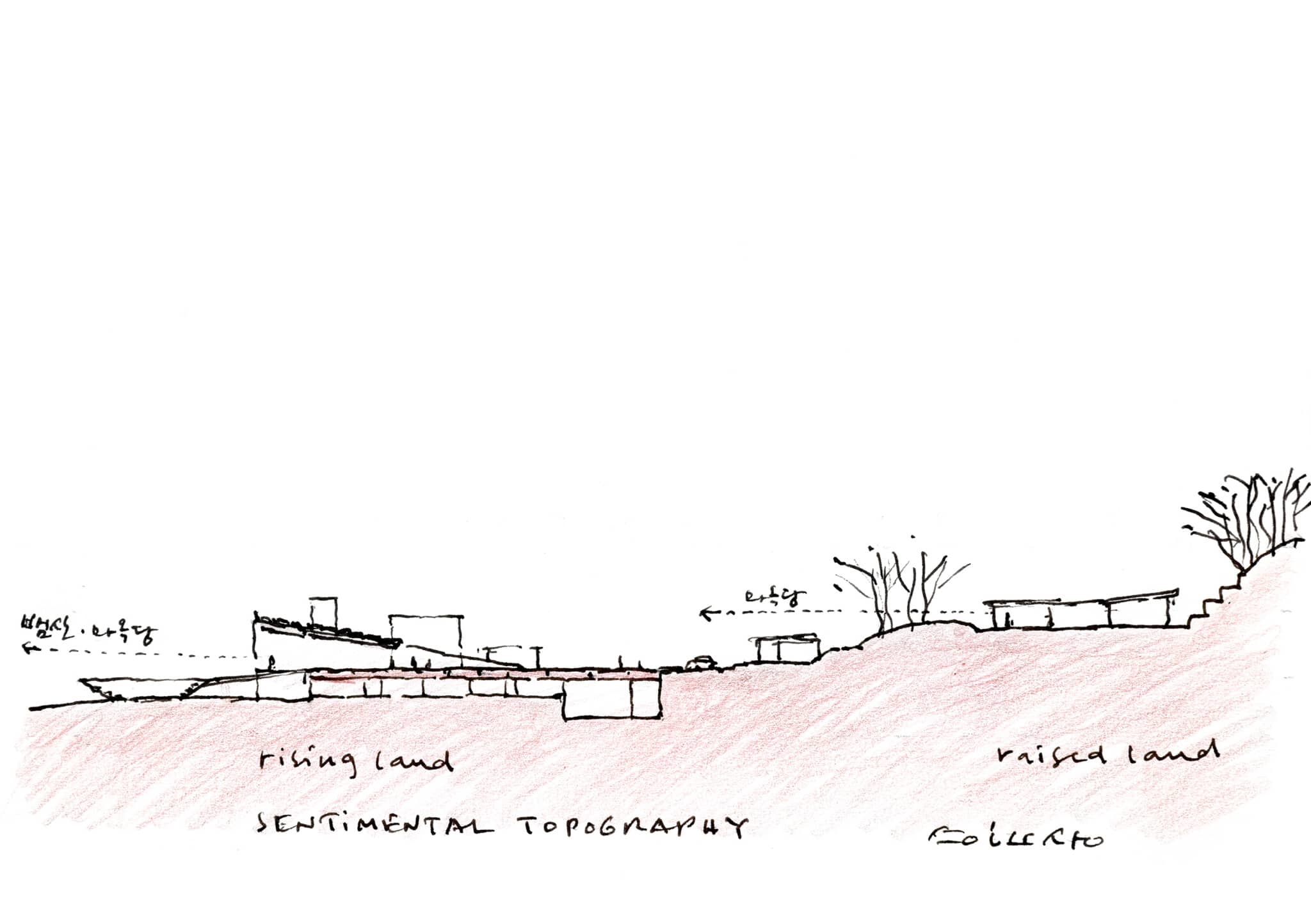
A conceptual section sketch for the Roh Moo-hyun Presidential Memorial. Notes like "rising land" and "sentimental topography" are layered again and again over the lines. Not a finished form, but the trace of redrawing, and hesitating, again and again.
© Seung H-Sang
You have to hesitate. This old habit of hesitation in the architect is more urgent and necessary now than ever, in this age of decisive AI.
What is it that keeps you hesitating like this, and keeps you staying in this place?
Looking at my own situation — still sitting at my studio desk in a fog of uncertainty well into my mid-seventies — I suppose I'm someone who regards architecture as an eop, and so I'm paying off, as karma, the anxiety and hardship that this profession carries with it.