A Controlled Factory and an Uncontrolled Jobsite
Since taking the lead of the society, what changes or challenges in construction automation and robotics have drawn your attention most?
The most important change I see is that construction automation and robotics are no longer limited to improving the efficiency of individual machines or specific tasks. They are emerging as a major force capable of changing the way the construction industry itself produces and builds.
Construction has long depended on the experience of skilled workers and their ability to respond to conditions on site. But demographic change, shortages of skilled labor, growing social expectations for safety, and stagnant productivity make it difficult to secure a sustainable future through conventional methods alone. I believe physical AI will be a key to overcoming these limitations. We are entering an era in which robots can perceive the jobsite, make decisions, and collaborate with people. The society must help ensure that this transition does not remain a passing technology trend, but develops into a new order and standard for the construction industry.
Unlike factories, construction sites change constantly. What makes deploying robots and AI in this environment different from automation in other industries?
Automation on a construction site is fundamentally different from automation in manufacturing. In a factory, the environment is controlled before robots are introduced. On a construction site, robots must adapt on their own to an uncontrolled environment. Ground conditions, weather, material conditions, worker movements, equipment interference, and construction sequences change constantly. Construction robots therefore cannot simply be machines that repeat predefined motions. They must become intelligent agents capable of understanding an imperfect and changing physical world. That is why I see physical AI as one of the central issues for the construction industry.
The construction robots of the future should not simply replace people. They should become partners that help people work more safely, precisely, and productively. I believe that philosophy should be the starting point for construction automation and robotics.
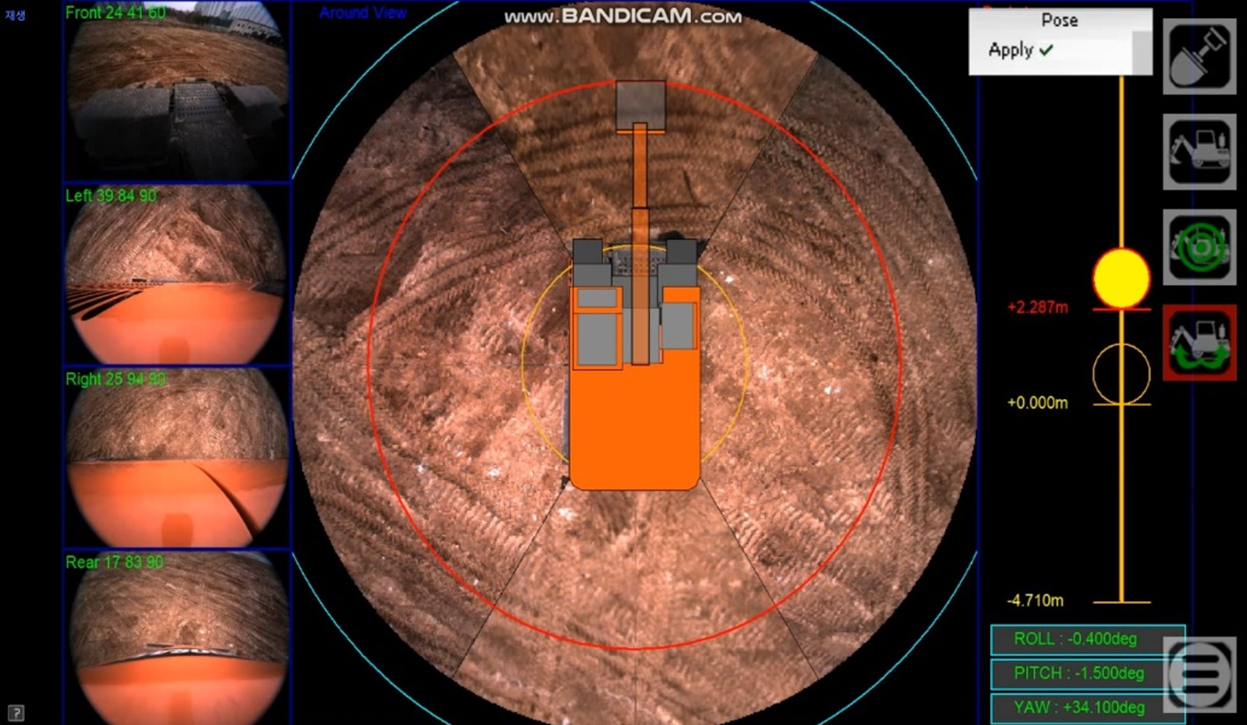
An excavator around-view monitoring system. Images from four cameras are combined into a single bird’s-eye view, revealing blind spots that cannot be seen from the operator’s seat.
Source · Korea Society of Construction Automation and Robotics
Some Tasks Will Be Automated First
Some tasks, such as material transport and concrete surface treatment, have adopted automation quickly, while others, such as finishing work, have progressed more slowly. How do you interpret that difference?
The speed at which construction robots are adopted cannot be explained by technology alone. Some tasks are highly repetitive, have clearly defined work areas, and involve significant risk or physical strain, so the benefits of automation become visible immediately. Material transport, drilling, demolition, and concrete surface treatment fall into this category. Finishing work, by contrast, depends heavily on human sensitivity, craftsmanship, and subtle quality judgments, so robotic adoption is inevitably slower. This is not because the technology is less advanced, but because finishing work itself is inherently more complex.
What matters, therefore, is not rushing to automate everything at once. We need to create successful cases first in areas where jobsite acceptance and economic feasibility are high, then use those results to expand into more sophisticated processes. In construction automation, direction matters more than speed, and understanding the jobsite must come before the technology.
In construction automation, direction matters more than speed, and understanding the jobsite must come before the technology.
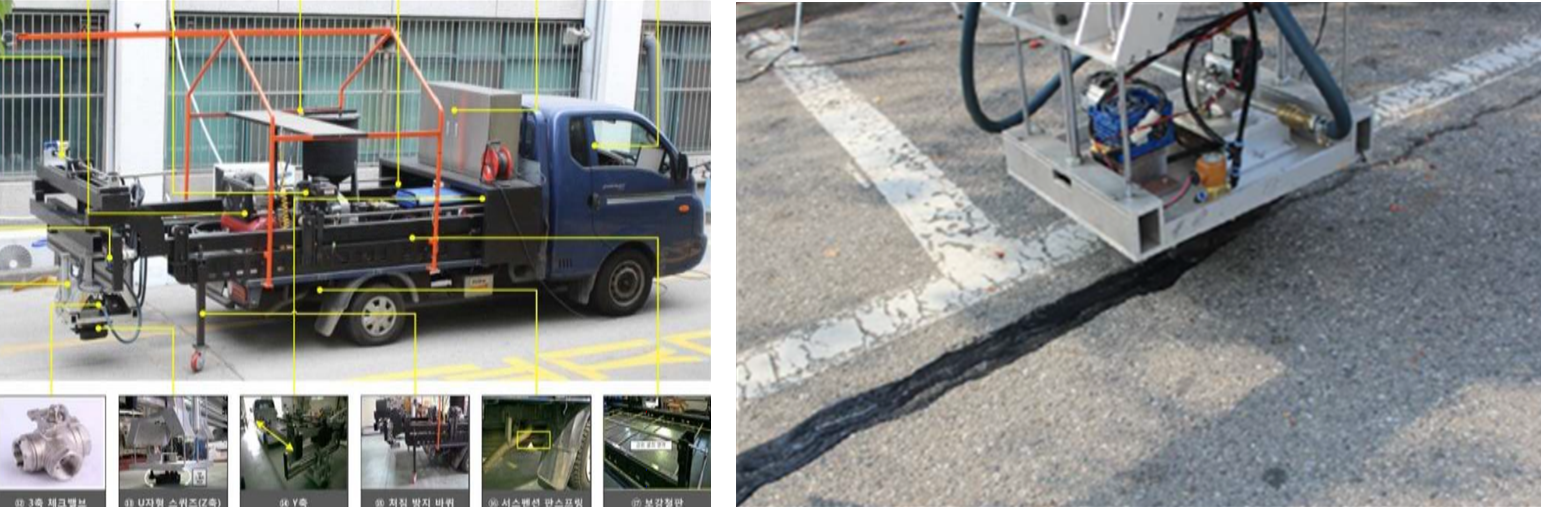
A field demonstration of a road crack-sealing robot. At left is the equipment mounted on a vehicle; at right, the robot fills sealant along a crack. It shows why repetitive, high-risk maintenance tasks are among the first to be automated.
Source · Korea Society of Construction Automation and Robotics
What It Takes for Technology to Survive on Site
The society’s role seems especially important if technology is to move beyond the laboratory and become established on real jobsites. Among research and collaboration with industry and government, where do you think the society should focus its efforts most?
I believe the society’s most important responsibility is “connection.” Researchers open up new possibilities, companies turn them into products and services, and government creates the institutional and policy framework that allows them to spread. But when these three areas move separately, technologies remain in the laboratory, industry cannot bear the risk, and regulation fails to keep pace with reality. The society must become a trusted platform that connects them. Construction robots in particular do not spread through technical performance alone. Demonstration sites, safety standards, performance evaluation, work standardization, procurement systems, and construction cost estimation frameworks all need to evolve together. For that reason, I believe the society must go beyond being an academic organization and also act as a catalyst for industry transformation, a source of policy proposals, and a coordinator of field demonstrations. That is our responsibility in this era.
I believe the society’s most important responsibility is “connection.”
You have personally developed robots across many areas, including road crack sealing, concrete pipe installation, intelligent excavation, and pile-head one-cutting and handling. How has that long experience shaped the way you now lead the society?
The greatest lesson I learned from developing construction robots myself is that good technology and technology that actually gets used are two different things. Through developing road crack-sealing robots, concrete pipe installation robots, intelligent excavation robots, and pile-head one-cutting and handling robots, I learned that design drawings and laboratory conditions can never fully explain a construction site. The site has soil, water, vibration, tolerances, schedule pressure, worker judgment, and the realities of equipment operation. In the end, a robot must not only be technically sophisticated; it must also be accepted by workers, fit naturally into the construction process, and make economic sense. For a researcher, creating a new principle or system may be important, but on site the more important questions are: “Who will use it, when, with what equipment, at what cost, and how safely?” That experience remains central to the way I lead the society. I believe we need a balanced perspective that goes beyond discussing what technology can do and also considers what it takes for that technology to survive on a real jobsite.
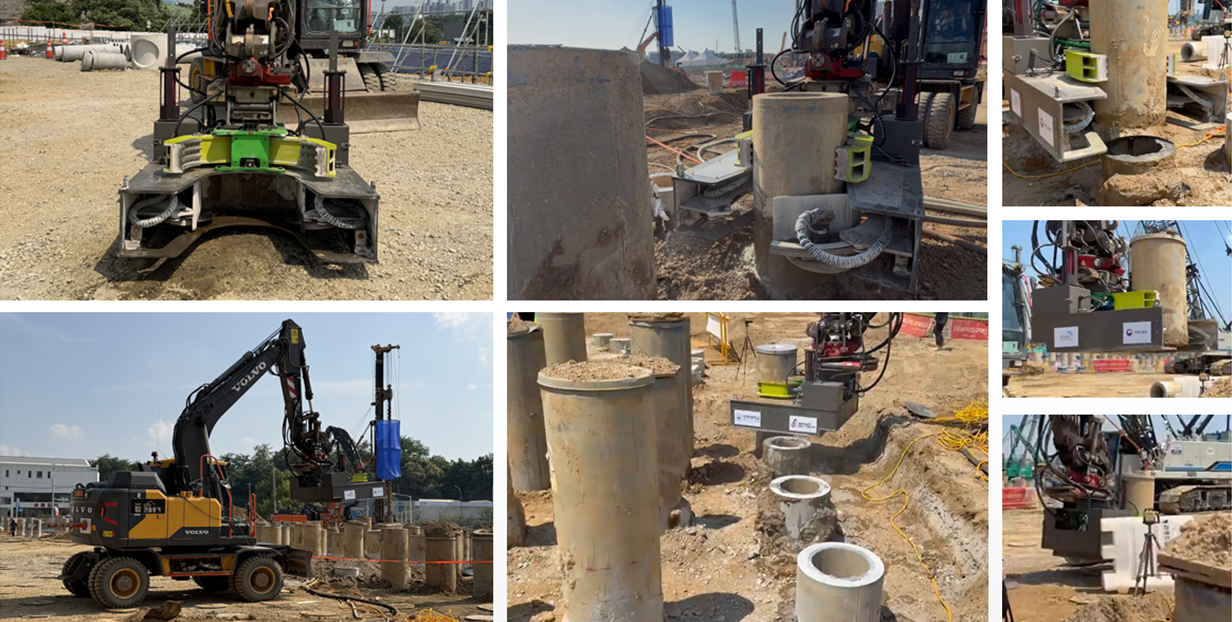
A construction-site demonstration of a pile-head one-cutting and handling robot. Mounted on an excavator, the system cuts off a pile head in a single operation, then lifts and moves it. Performance is proven not under laboratory conditions, but amid soil, vibration, and real-world tolerances.
Source · Korea Society of Construction Automation and Robotics
What would you like to tell architects, contractors, equipment and building-systems companies attending this technology seminar, as well as representatives from academia, research, and government, about the changes coming over the next few years?
The next few years will be a critical period that determines whether the construction industry remains bound by the inertia of the past or makes the leap toward a new production system. Architects must now go beyond designing beautiful spaces and also consider constructability that enables robotics and automation. Contractors need to move away from management centered on labor input toward process operations that combine data, equipment, and AI. Equipment and building-systems companies must become providers of intelligent construction solutions rather than simple hardware suppliers. Universities and research institutes need to strengthen practical research that begins with real problems on site, while government must establish the foundation for technology adoption through demonstrations and regulatory reform. I see construction automation and physical AI not as technologies that undermine the essence of construction, but as tools of progress that can make construction safer and more sophisticated. I hope this technology seminar will become a starting point for that transition.